






















From Tourist to Resident: The Step-by-Step Transition Without Leaving Panama


Introduction: Why Panama Makes the Tourist-to-Resident Transition Possible
The country of the canal has proven to be highly oriented to residency, allowing foreigners to legally establish themselves in its territory.
However, the reality is that many foreigners enter the country as tourists and then transition into a more stable condition. Since for many nationalities the tourist visa lasts six months, this is totally feasible and, at times, convenient. Today, we explore the details of how to change a tourist visa to a resident visa in Panama.
Change tourist visa to resident visa: Panama’s seamless transition
The Strategic Advantage of Applying In-Country
The world is becoming ever more complex, and so are the lives of international investors and global citizens. It is only natural that they look for ways to save time and streamline processes as much as possible. With that said, let's put ourselves in the shoes of a prospective applicant.
Most residency processes require physical presence at least in two different moments. This translates into two visits, sometimes with the whole family, and with plenty of arrangements to make: from missing school to ticket expenses and accommodation.
If the goal is for the family to establish itself in Panama, then why not do it from day one? Starting the process with a tourist stay, they save themselves the trouble of long trips and high expenses; moreover, they remain available when required by the migration office.
When the application is finally approved, the applicant will be happy to have made all the settlement arrangements in advance. Now, all that is there to do is enjoy the residency in Panama and dedicate oneself to fulfilling other objectives.
Who This Guide Is For
We have drafted this guide with a special type of investor in mind. We're talking about an applicant who is planning a permanent stay in the country, especially if they have a family. Such an approach is better suited to those nationalities who can remain in Panama as tourists for six months.
Understanding Panama’s Residency Framework
Temporary vs. Permanent Residency: Key Differences
All the Panama programs together constitute a complex tapestry; nevertheless, we can break down their characteristics and understand them more in depth when we categorize them. For instance, we can see a clear separation between programs granting temporary residency vs those granting a permanent permit.
Naturally, you trade off a permanent status for lower investment thresholds, which in some cases exist within the same program.
Temporary alternatives vary from the nomad digital visa to the self-solvency program and the Friendly Nations, known for its innovativeness and straightforwardness. On the other hand, there is the Qualified Investor, which grants immediate permanent residency, and Reforestation, with a mixed approach (see table below).
| Program | Type | Threshold | Residency length | Comments |
| Pensionado | Monthly pension | 1,000/month | Permanent | Not age restricted |
Friendly Nations | Financial connection | 200,000 | 2 years | Available to citizens of certain countries |
Self-solvency | Investment | 300,000 | 2 years | Too expensive when compared to QI |
Qualified Investor | Investment | 300,000/500,000/750,000 | Permanent | Best cost/benefit ratio |
| Reforestation | Investment | 100,000/350,000 | 2 years/permanent | Expected returns in 25 years |
Digital nomad | Monthly income | 3,000/month | 9 months | Doesn’t allow work in the country |
Legal Requirement: Mandatory Representation by a Licensed Panamanian Immigration Lawyer
At this point, one may ask: if I'm going to make the change while staying in the country, couldn't I just apply by myself? This is a very good question, and as such, it leads to a straight answer: you can't. All visa processes must be led by a Panamanian lawyer specializing in migration.
How the Migration Office Processes In-Country Applications
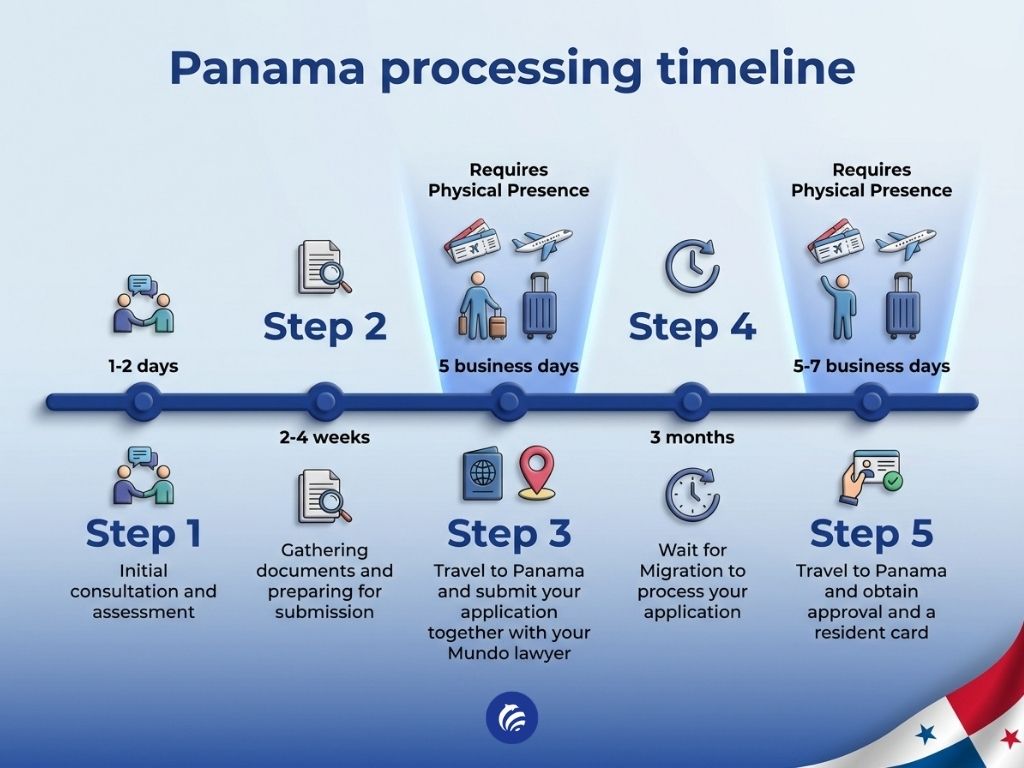
Interestingly, the migration office doesn't process residency any differently. The important thing is that you comply with the legislation and appear in person at two key stages: the moment of submitting the application and the moment of receiving the letter of approval.
In Mundo's view, the main benefit derived from this change from tourist to resident is practicality and faster immersion, as the family can get acquainted with the country way before the visa is issued.
Preparing Your Documentation While on Tourist Status
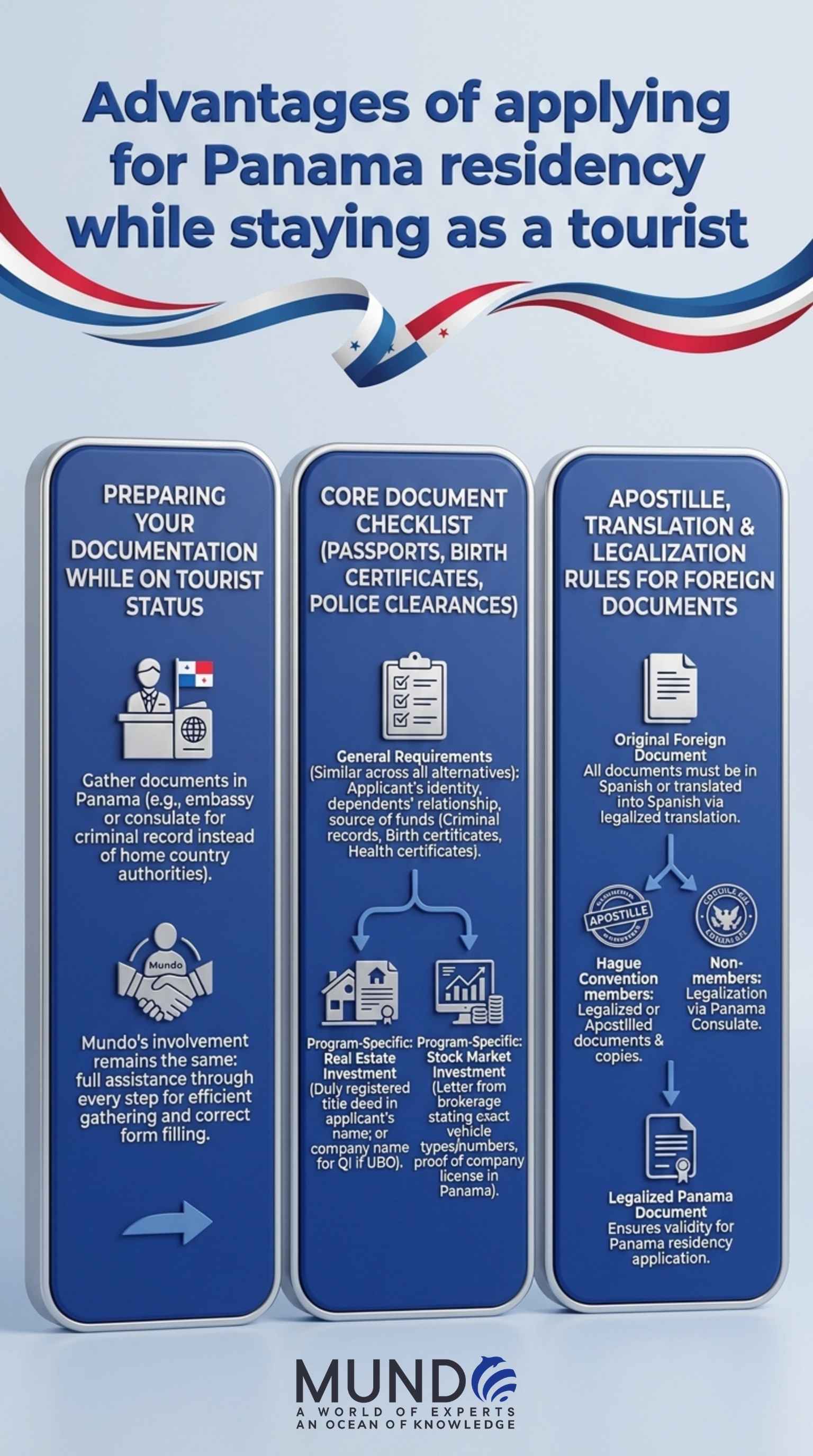
If you choose to change from a tourist visa to a permanent one, you will probably gather most documents in Panama. For instance, instead of obtaining your criminal record from your country's authorities, you will go to your country's embassy or consulate in Panama.
As for Mundo’s involvement, it will be exactly the same: we will help you through every step so that you can gather your documents efficiently and fill your forms correctly.
Core Document Checklist (Passports, Birth Certificates, Police Clearances)
The documents vary according to the case and the program. To help the reader get a general overview, we've chosen the requirements stipulated by the Friendly Nations Visa. Generally, all requirements that involve the applicant's identity, the relationship with dependents, and the source of funds are similar across all alternatives. This entails criminal records, birth certificates, and health certificates.
The changes come when proving the requirements specific to each program. If a visa requires a real estate investment, naturally, the applicant must submit a duly registered title deed stating that the property is under his or her name. In the QI, it can be under a company’s name as long as the main applicant is the UBO.
If the visa requires investment in the stock market, then they will need to submit a letter from the brokerage company stating the exact number and types of vehicles, and proof that the company exists and is duly licensed to operate in Panama.
Documents needed for Panama residency on a general basis
- Power of attorney (it must state the name and nationality of the applicant's parents)
- Three passport-sized photographs (consult with your Mundo expert about the specific requirements for such photographs)
- Copy of the entire passport (all pages); must be notarized or apostilled
- Criminal record certificate
- Health certificate
- Sworn affidavit regarding personal background
- Check for $250 to the National Treasury
- Check for $800 to the national migration service
- Marriage certificate if applying with spouse
- Birth certificate if applying with children
- Certificate of being a full-time student at the university for children older than 18
- Sworn affidavit that the children over 18 are unmarried
- Proof of economic solvency, demonstrating that the applicant can support himself and his family in the country
Apostille, Translation & Legalization Rules for Foreign Documents
All documents must be in Spanish or translated into Spanish through a legalized translation. Furthermore, all documents and copies must be legalized or apostilled if the country of origin is a member of the Hague Convention.
Financial Proof Requirements by Visa Category
Proving solvency is possible in different ways. The applicant can present a declaration of income in which they prove receiving a salary of $1000 a month plus $100 for each dependent. Other options are presenting a current work letter and proof of being registered in the Social Security system, in which case, they will have to submit a work permit too.
Another popular way is to maintain a certain amount of money, usually $5000, in a bank account. It's important to note that this isn't money that you pay: you just have to maintain it untouched until the national Immigration Services confirms your solvency.
Disclaimer: Due to the changing nature of all legislation, the information stated here about Panama visas may be outdated at the time of reading. This article doesn't constitute legal or migration advice. Before applying to residency, always consult with certified professionals.
Common Document Errors That Trigger Rejections or Delays
Mundo’s experts advise clients to provide eligible documents and reliable copies that faithfully reflect the document and all its writing. All translations must be carried out by certified translators, and documents that are originally in Spanish should be notarized or apostilled.
Choosing the Right Residency Path for Your Profile
Pensionado (Retiree) Visa: Income Thresholds & Perks
The pensionado visa may be known as a retirement visa, but it's actually for people of all ages. The main requirement is to have a lifetime pension of at least $1000 a month, which can come from any type of source (government or private).
Combining the pensionado visa with a real estate investment is a natural choice. The threshold is $100,000, much lower than you will find on any program, and in this case, the pension can be reduced to $750 a month.
Pensionado allows you to apply with your spouse and your children; if the children are older than 18, they must be full-time students at the university. Dependent children find a barrier at the age of 25. Sons and daughters of the main applicant can't be older than 25 years old; furthermore, if they obtained residency through pensionado, they will lose this status at the same age.
Mundo expert’s opinion: "Among all the residency alternatives in Panama, Pensionado is one of the best. In my view, this is the easiest and most inexpensive path to permanent residency. I recommend it to everyone who has a pension and who is looking for an actual permanent relocation rather than short visits".
Friendly Nations Visa: Eligible Countries & Economic Ties
This visa is unique, catering only to applicants who come from certain countries. These are countries that Panama considers to be friendly, and hence it gives its citizens the possibility to apply. Although the list varies, some regulars are the US, Canada, the EU members, the UK, Costa Rica, Mexico, Brazil, and Argentina.
Besides, applicants must meet a second requirement consisting of having economic ties with the country. According to the executive decree 226 of 2021, this can be proven through the following:
Job contract
If a foreigner is hired by a Panamanian company with the corresponding legal contract registered in the Ministry of Labor, he/she is eligible for the Friendly Nations. It's worth noting that it can't be a professional service contract; it has to be a full-time job with Social Security benefits and everything stipulated by law.
200,000-dollar Fixed-term deposit
Through a fixed-term deposit, the applicant demonstrates his or her connection to the country of the canal. Providing that they have the correct nationality, these grants a direct path to Panama residency.
200,000-dollar real estate investment
Instead of a bank deposit, they can choose to invest the same amount in real estate. The property must be duly registered in the National Register and be in the main applicant's name.
Mundo editor’s opinion: “Some readers wonder which investment path is most convenient. In my view, as Mundo’s editor, I would say real estate. Unless you have a very specific interest in the stock market or fixed-term deposits, real estate is truly a field of opportunity. Of course, you can use it as a personal residence, and since most developments have short-term rental licenses, they can be a good source of passive income. My favorite part is that these two approaches can be combined, as many developers offer flexible rental management terms”.
Qualified Investor & Real Estate Routes
Last but not least, there's Panama's investment program par excellence: the Qualified Investor. What may seem like a regular investment route to residency, with thresholds of $750,000 in bank deposits and $500,000 in the stock market, becomes interesting when it's about real estate.
The real estate minimum threshold is considerably lower: only $300,000, and although there are rumors that it may be raised soon, this hasn’t changed since the program's launch. Only for its real estate path, QI is worthy of attention as it's much more solid than similar European programs.
Flexible stay, dependents, and freedom of choice
With Panama residency, there are flexible stay conditions requiring just a visitation every couple of years. On top of that, applicants can add their spouse, children, and parents, which is more than enough when compared to other residency programs.
One should not overlook one key advantage: the total freedom of choice, as the real estate can be located in any region of the country, and it doesn't have to be pre-approved by the government.
Digital Nomad / Remote Worker Visa
On the other side of the scope, there's the digital nomad visa, officially known as the Remote Worker. This alternative is ideal for those who want to spend a limited time in the country as it is not renewable more than once.
Without the need for an investment, all it takes is a fixed, stable income coming from foreign sources.
Self-solvency
Finally, the self-solvency visa grants a 2-year permit in exchange for an investment, which can be in real estate or a fixed-term deposit. Since the Qualified Investor Visa currently has the same minimum threshold, it's more convenient because it grants permanent residency. Self-solvency will surely become more popular if QI ever increases the investment.
Maintaining Legal Status While You Wait
Your Panama journey can begin as a tourist
All in all, all applicants can apply while still living as tourists, especially those who can spend six months with this status. As long as the foreigners keep themselves informed on the migration requirements, there's no risk to this approach.
On the contrary, it’s convenient since it allows newcomers to settle in Panama while initiating the residency process. Once they submit the application, they will obtain a temporary card, which will allow them to extend their stay beyond the original tourism permit.
Who we are
We are a specialized publication concentrated on topics for the global investor and citizen. We publish across categories that include banking, corporate, asset protection, real estate, and expat lifestyle.
Click on the buttons below and get in touch with our team of professionals who are ready to assist you in obtaining any of the above-mentioned services.


.png.small.WebP)


.webp.small.WebP)


$347,000
$309,100
$300,000
$250,000
$424,000
If you haven't yet considered Panama as a possible retirement place or relocation hub, you don't kno...
Deeply committed to second residency and citizenship, Mundo doesn't miss the chance of attending imp...
Panama may have lost its first game in the FIFA World Cup, but the tournament is just starting. We a...
Many of our readers are concerned about the risk of buying property abroad. Any foreigner embarking ...
Panama enjoys a rare combination of factors that contribute to making it a real estate hub in the re...
When there's a new program in the CBI world, everyone talks about it. Comparisons are common between...