



























Why Panama’s Qualified Investor Visa Is More Flexible Than Other Latin American Investor Programs


Overview of Panama Residency Programs
The word “Panama” keeps ringing in conversations about residency by investment. Today, we focus on the Panama QIV vs Colombia investor visa while touching upon other options in the country of the canal.
For every investor out there, Panama is attractive because it has the typical investor visa (similar to European golden visas), non-investor alternatives, and interesting options in between. Let's delve into the QIV (qualified investor visa) and its counterparts in the land of birds and butterflies and the neighboring Colombia.
Benefits of Panama Residency by Investment
The investor visa, per se, is called the Qualified Investor Visa, although other options propose investments too. Undoubtedly, the main advantage of the said program lies in its accessibility and low cost, as the reader can see in the following paragraphs.
Low investment entry
The minimum investment for the QIV is $300,000 in real estate (read below to see all the options), which is far less than typical golden visas on the old continent. Here, without an exorbitant amount, the applicant and the family obtain permanent residency.
Immediate permanent residency
The best of it all is that applicants obtain immediate permanent residency, thus avoiding the hassle of constant renewal efforts.
Flexibility in terms of physical presence
We all love having freedom, and strict physical presence conditions may limit that freedom. In Panama, a short visit for two years is enough to maintain the status, thus assuring excellent terms.
Freedom to choose whatever real estate you prefer
Unlike the countries in the Eastern Caribbean (offering CBI), the Panama government doesn't have to preapprove the developments involved in the QIV application. Any project or unit that meets the minimum investment qualifies.
Benefits of the QIV in a nutshell
- Immediate permanent permit
- Flexible terms
- Low minimum amount
- Investment in real estate, stocks, and fixed deposits
- No “government-approved” conditions
- Excellent lifestyle
- Great connections and strategic location
- Dollar-based economy
- Convenient taxation
- Territorial taxation system
- Outstanding landscapes
- State-of-the-art real estate
- Coastal living and experiences
- Advanced infrastructure
- One of the strongest economies in Latin America and the region
Beyond QIV: Types of Residency Programs in Panama
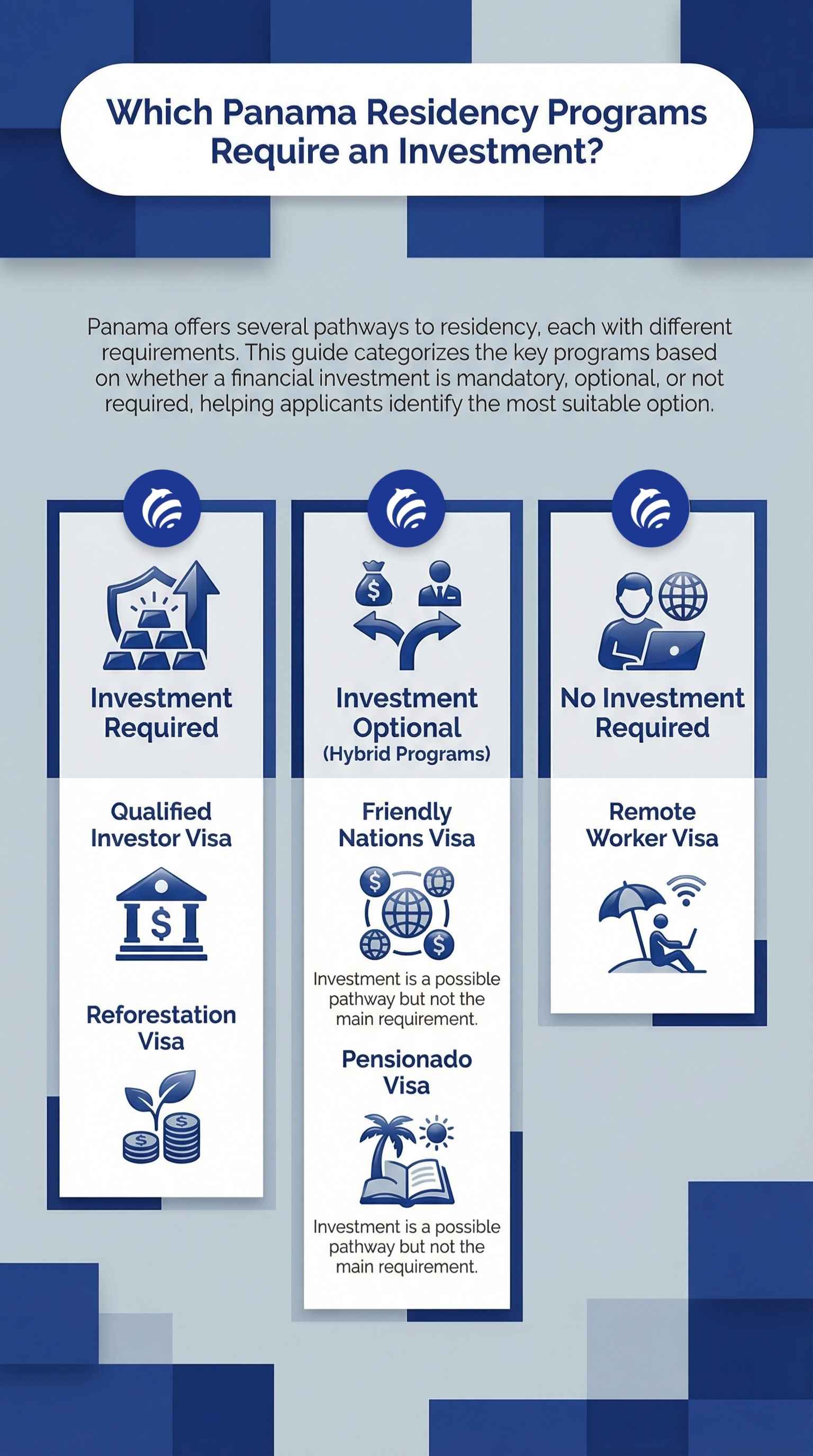
For the sake of clarity, we established 3 categories: investment programs, hybrid programs, and non-investment programs.
Programs that require investment
1. Qualified Investor Program
This is the simplest and most straightforward alternative, with its only eligibility criteria being having the money to invest.
Thus, the applicant may choose from three possible pathways: real estate (USD300,000), fixed-term deposit (USD750,000), or vehicles in the local stock market (USD500,000). Its main advantage is that it's the only program that grants immediate permanent residency.
2. Reforestation Residency Visa Program
Also with an investment, the reforestation program invites applicants to invest in teak land. The offering is highly convenient. Mundo has partners that take care of everything from helping you obtain residency to planting the trees, maintaining them, and harvesting them.
It constitutes an outstanding option for those who want to see returns in the long run because the trees take approximately 25 years to grow. According to the corresponding decree (Article 180), the lowest entry stipulates a minimum of $100,000, providing a 2-year permit residency (with the possibility of renewal), while the $350,000 investment provides a permanent status. It's interesting to note how these two programs have common ground, as we can see in the following comparison.
QIV vs Reforestation: A Quick Comparison
For those who want to obtain immediate permanent residency, both programs offer similar thresholds, with a difference of only $50,000 (see the table below). The difference lies in the reforestation visa, which allows you to invest less; however, permanent residency will have to be postponed after the first two-year period ends.
To sum up, it all comes down to how much you are willing to pay and how long you are willing to wait for permanent residency. Those who don't see themselves in the long term may be satisfied with the simpler reforestation.
More information about Panama residency
Hybrid programs (investment is optional)
We call hybrid programs those initiatives that contemplate investment as an option without making it mandatory.
3. Friendly Nations Temporary Residency Program
The friendly nations visa stipulates two main requirements: a) being from a country that's considered friendly, b) having financial ties to the Republic of Panama.
These ties can be proven through a) a job contract in a Panamanian company, duly registered in the Ministry of Labor, b) through the formation of your own company, hiring yourself with salary and Social Security, or c) through an investment of at least $200,000 in real estate.
The reader can draw his/her own conclusions: the investment threshold is lower, but it requires having a previous nationality, and it grants residency for only two years.
Some of the countries included in the friendly nations list are:
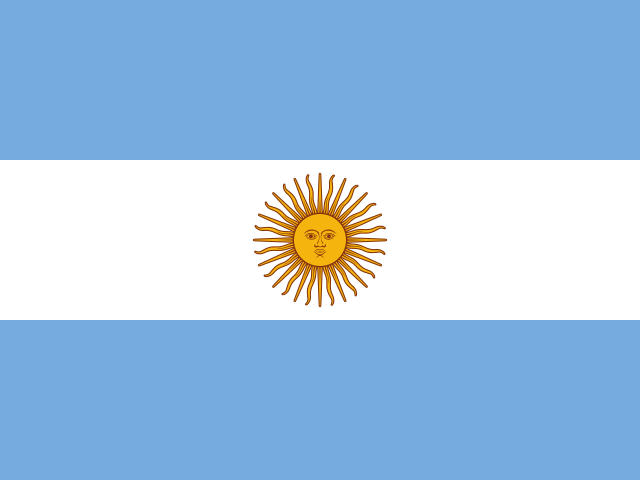
- Argentina (Latin America)
- Brazil (Latin America)
- Costa Rica (Latin America)
- Uruguay (Latin America)
- Chile (Latin America)
- United States of America (America)
- Canada (America)
- Andorra (Europe)
- Austria (Europe)
- Belgium (Europe)
- Cyprus (Europe)
- Denmark (Europe)
- Germany (Europe)
- Poland (Europe)
- Latvia (Europe)
- Lithuania (Europe)
- Sweden (Europe)
- Switzerland (Europe)
- United Kingdom (Europe)
- France (Europe)
- Finland (Europe)
- Spain (Europe)
- Australia (Oceania)
- New Zealand (Oceania)
- South Korea (Asia)
- Japan (Asia)
4. Retirement and Pensioners Residence Visa
This program is specially chosen by Americans, Canadians, and Europeans from Spain, France, Germany, and other high-cost countries. For these citizens, having a pension or a retirement of at least 1,000 dollars a month is not unusual, and this gets them right into the pensioners residency, or what it's actually called: “Pensionado Visa”.
Everyone is eligible as long as they have a minimum lifetime pension of at least $1000 a month, which can come from any source. For couples, if they both have pensions, they can combine them to reach this amount.
It comes with a number of benefits for those who retire in Panama and has a unique perk: it's not age restricted. Finally, it falls into our “hybrid” category because it contemplates real estate: by purchasing a property of at least $100,000 in Panama, the applicant can lower the minimum pension to $750.
Options without investment
5. Digital Nomad Residence Visa
Last but not least, there's the digital nomad visa, officially called “remote workers’ visa”. In this case, there's no investment included, and the permit is viable for nine months (renewal is available for another nine months).
The main condition is having an income of $3000 a month purely derived outside of Panama and from sources abroad (own company or clients). In our view, this is a nice program for those who are just beginning to explore this jewel of Latin America.
Eligibility Criteria for Panama Residency
General Requirements
In general, applicants will have to prove that their investment comes from abroad and from legal sources, present two IDs, certificates proving the relationship with the dependents, a medical certificate, and proof of solvency.
Specific Requirements for Each Program
To provide the reader with a visual aid, we prepared this table summarizing the specific requirements for each program.
| Program | Main requirement | Type of investment | Minimum threshold | Length of visa |
| QIV | Investment | Real estate/stock market/fixed deposit | 300,000/500,000/750,000 | Permanent |
| Reforestation | Investment | Teak land | 100,000 | 2 years |
| Reforestation | Investment | Teak land | 350,000 | Permanent |
Friendly Nations | Prove financial ties + being from a friendly country | Real Estate/Establishing your own company | 200,000 (real estate) | 2 years |
| Pensionado | Lifetime pension | Real estate (optional) | 1,000/month | Permanent |
Digital Nomad | Income derived abroad | No | 3,000/month | 9 months |
Who are these visas best for?
Case study 1: Applicant from the US who seeks long-term savings
A person from the US wants residency in Latin America, but he/she is not ready to commit to constant physical presence. Instead, he/she wants to save money for the children's college. The person would probably choose to invest $100,000 in the reforestation program through which they can obtain returns in 25 years (remember, they don't mind the wait).
Case study 2: Applicant who wants to move
A completely different case is that of the person who wants residency to establish a permanent presence. The individual/the family will need a place to live. For them, the QIV is the right way to go because it offers immediate permanent residency, while the real estate can be used as the family base, most conveniently.
Case study 3: Applicant who wants long-term savings but is from a friendly country
If any of the two previous cases were from a friendly country, Friendly Nations would be more convenient, purchasing a real estate for $200,000. In this case, the apartment must be duly registered.
Case study 4: Applicant who wants passive income
25 years can be a long time to wait for returns. This is why many choose the QIV to access one of the best economies in Latin America. Under these terms, they can put the properties on the rental market and obtain benefits through rental income. In this sense, the country is well prepared, as several projects come with an extremely convenient short-term rental license.
Case study 5: Applicant who doesn’t want any complications
Even though most of the real estate in our portfolio comes with optional rental management services, some people don't want to deal with the responsibility of maintaining an apartment. On top of that, if they are not planning on establishing a physical presence, they may choose to invest in the stock market or a fixed-term bank deposit, even if the thresholds are higher.
*Note: All cases are hypothetical. This article doesn’t constitute migration or investment advice. The information presented here may be outdated at the time of reading; therefore, make sure to consult with certified professionals.
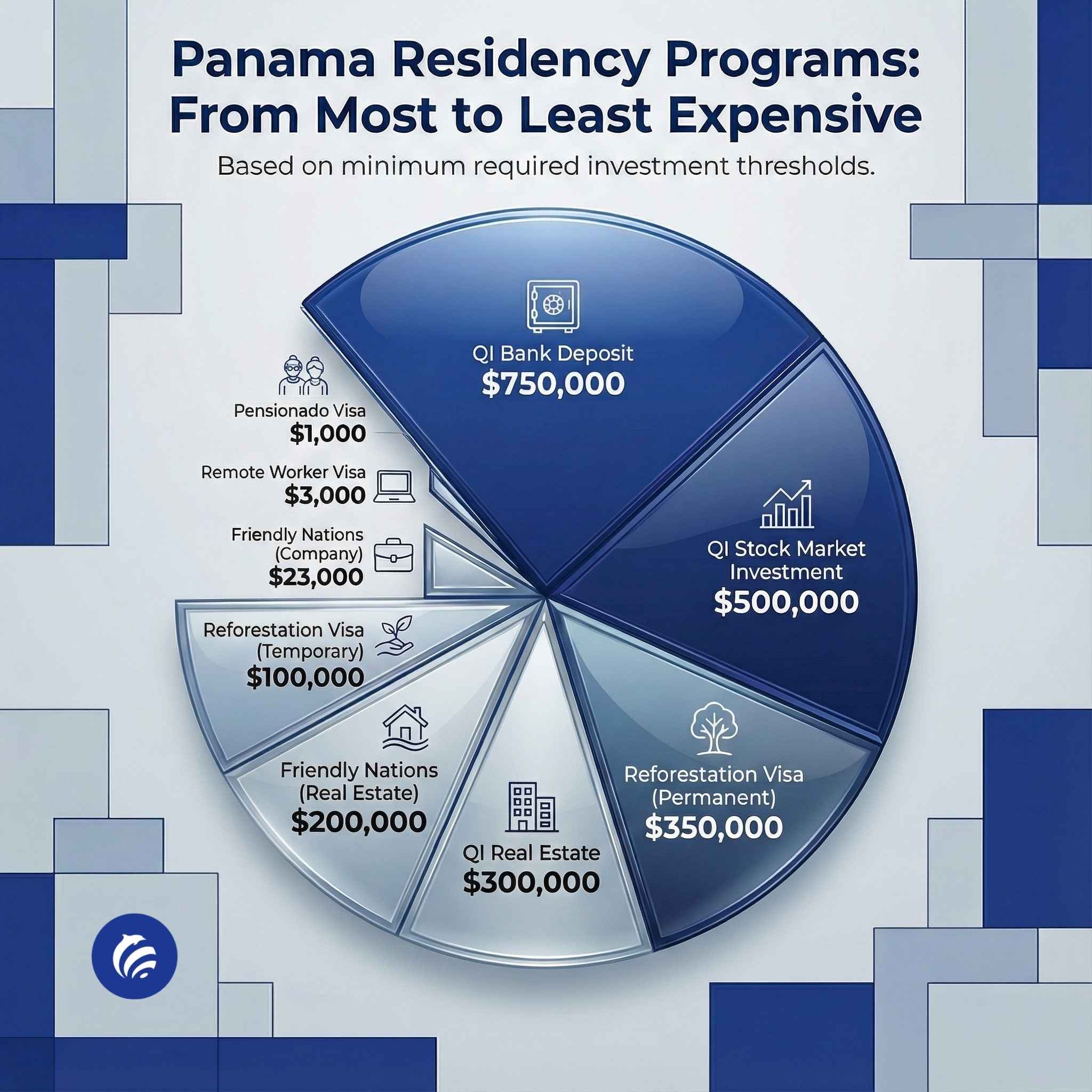
Panama Visas organized from the most expensive to the least expensive
Application Process for Panama Residency
Step-by-Step Guide to Applying
- Gather the documents and fill out the forms
- Pay all necessary fees
- Open a bank account and make a deposit to prove solvency
- Present the documents to the migration office (may require physical presence)
- Wait for the revision period (usually a few months)
- Travel to the site and obtain your resident card
- Apply for your Panamanian Cedula (only if you obtained permanent residency)
Document Requirements
At this stage, the applicant will have to provide proof or whatever factor makes him/her eligible. If it's a real estate purchase, they will have to submit a publicly registered certificate that demonstrates ownership of the real estate. It can be under the applicant's name or under a company of which the applicant is the ultimate beneficial owner.
For the friendly nations visa, the process might be financed through a local bank, and for QIV, the applicant must pay the $300,000 up front, with funds that must come from foreign sources (should the property be more expensive, the remainder can be paid through mortgages with a local bank).
If the application includes dependents, the applicant must sign a letter making himself/herself responsible for each dependent and prove kinship.
Processing Times
As stated above, processing times can vary; nevertheless, they usually take between three and six months.
Costs Associated with Panama Residency
Visa Fees
In most programs, the applicant will have to pay a fee of $250 to the National Treasury and $800 to the migration office to cover potential deportation costs.
*This doesn’t include legal fees or related costs, e.g., cost of translations, apostilles, medical certificates, letters, issuance of documents, etc.
Pathway to Citizenship in Panama
Once the resident has obtained permanent residency, if he has a constant physical presence, he becomes eligible for naturalization. One way or the other, each of the programs described here provides a pathway to citizenship (except for the remote worker visa). It's worth noting that obtaining nationality forces the individual to renounce any previous nationality they may have.
FAQs about Panama Residency
What are the primary benefits of obtaining residency in Panama?
For those who want a second residency without a strong visiting commitment, Panama programs are among the best and most flexible ones not only in Latin America, but on the globe. On the other hand, if the applicant intends to live in the territory, he/she will find one of the most prosperous nations in Latin America, enjoy a dollar-based economy, a cosmopolitan environment, high living standards, exclusive real estate, thriving business scenery, great nature, and the charms of the tropics.
How long does it take to obtain Panama permanent residency?
It can take from three months to several years, depending on the chosen program. Some programs, like the Qualified Investor and Reforestation, offer immediate permanent residency, while others offer a temporary permit. This can later be renewed until eventually obtaining permanent residency.
Can my family be included in the application?
Yes. Spouse and children under 18 can always be included in the applications. Children older than 18 need to prove that they are financially dependent on the main applicant and are formally studying at the university.
Are there any restrictions on working while holding Panama permanent residency?
If the program allows it, the work permit is not difficult to obtain, yet it's vital to note that working in the isthmus as a foreigner is ILLEGAL unless you ask for the proper permit. Most of the programs allow you to apply for a work permit, which will last for as long as the migratory permit lasts.
Another important aspect is that (regardless of their visa and regardless of whether they have a working permit) foreigners in Panama cannot work in certain professions like medicine, veterinary, law, accounting, engineering, architecture, dental medicine, therapy, and others.
Latest News and Updates on Panama Residency Programs
During 2025, one of the most exciting news was the travel document included in the QIV visa since October 2025. Such a document adds a unique allure to the program as a traveling tool and an instrument to facilitate travel in Latin America and the world.
Conclusion: Why Choose Panama for Residency?
To conclude, it is safe to say that Panama constitutes one of the best residency destinations in Latin America thanks to its wide array of permits. When compared to neighboring countries, like Colombia, Panama stands out thanks to its flexible terms.
In Colombia, the minimum real estate investment has to be 350 minimum salaries while registering the purchase as a direct foreign investment. In the country of the canal, options barely start with real estate.
The possibility to choose a short-term or long-term strategy, buying a unit in a modern complex, or simply depositing a good sum in the bank is out there and ready to welcome you.
After all, it's still clear why Panama is still positioned as one of the expat, investment, and business hubs in Latin America. It is only fair to say that this position has been well earned. Contact the Mundo team and inquire about any of the programs.


.png.small.WebP)


.webp.small.WebP)


$347,000
$309,100
$300,000
$250,000
$424,000
When there's a new program in the CBI world, everyone talks about it. Comparisons are common between...
Today, we go back to analyzing the new African CBI program, which has been on the lips of experts an...
The migration world has been increasingly tied to finances since wealthy people started to choose sm...
The financial world is facing dramatic changes, and structures need to be ready to accompany clients...
When discussing asset protection, there are several myths, marketing lines, and promotions; hence, i...
“Pensionado discount” is a colloquial expression that refers to Panama’s pensionado visa and its lif...