

















São Tomé vs St. Kitts & Nevis: Which Citizenship Program Is Better for Americans?


Introduction: Dual Citizenship Dreams for Americans
More and more people are deciding to obtain dual citizenship, especially Americans, Canadians, Western Europeans, and those from high-tax and overly regulated jurisdictions. Today, we analyze two key programs in the CBI industry. We present a detailed São Tomé vs St Kitts citizenship guide, a comparison of the main requirements, common grounds, and differences.
Why U.S. Citizens Seek Second Passports
High tax rates, a controlling state, and the increasing geopolitical conflicts are driving U.S. citizens to more neutral places. Even if they don't give up their original nationality, they seek a parallel alternative where they can safely enter, live, and stay for as long as they want.
Besides, a second nationality can constitute a Plan B in case the individual or family wishes to move to another country.
Overview of São Tomé and St. Kitts & Nevis Citizenship-by-Investment Programs and Comparison
Two of the most sought-after alternatives exist in the West Indies and across the ocean in an African country: São Tomé and Principe. The Mundo editorial team knows their relevance and how a thorough comparison can be of use to the reader and potential applicant.
Comparison of Program Basics
Legal Framework and Government Oversight
In St Kitts, the citizenship framework is overseen by the Citizenship by Investment Unit. This regulatory organ is in charge of following up on the process from the moment of application to the moment of nationality issuance. They are responsible for maintaining the country's reputation according to international standards and ensuring transparency.
It also oversees agents to ensure compliance and adherence to the program’s rules. If any agent or developer infringes them, they might be fined or have their licenses removed.
The current unit was established through Act 11 of 2024, stipulating its responsibilities, composition, and further details such as remuneration, liabilities, staff, funds, and confidentiality.
Furthermore, two years ago, the five West Indies countries signed a memorandum of agreement according to which they will establish unified checks, controls, and follow-ups. Since the signature, they've been moving forward towards the goal, firstly updating their minimum investments to reach a common ground.
One of the most significant additions will be the constitution of a regulatory organ that will apply across the five countries, ensuring transparency, fair accountability, enforcement, and follow-up during and after the processes.
On the other side of the comparison, the program is regulated by the Citizenship Unit of São Tomé & Príncipe, which is headquartered in Dubai.
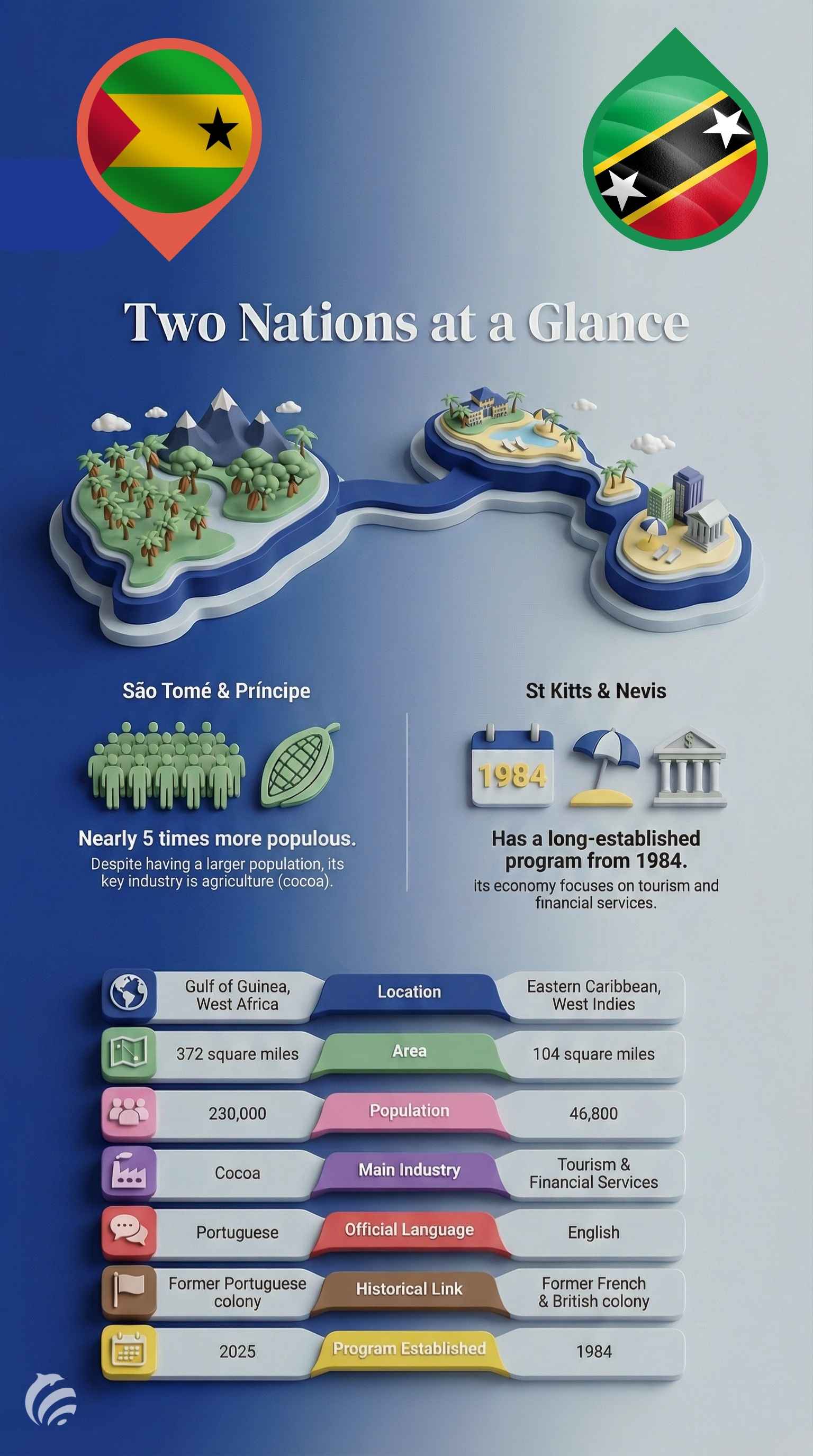
Two Nations at a glance
Minimum Investment Requirements and Options
In the African nation, the main path is through a donation to the national fund, while in the Caribbean island, there's (besides a similar donation), a public benefit option, a private real estate investment, and an investment in real estate developments.
It's interesting to see how the contributions to national development are focused on distinctive areas. São Tomé, a nation classified as a UNESCO biosphere reserve, is consequently committed to eco-tourism, nature preservation, and sustainability, while Saint Kitts is mostly focused on developing urban infrastructure.
Comparison of entry requirements in both players:
- Contribution to the national transformation fund (São Tomé, donation)
- Focus on developing national projects related to renewable energy, sustainability, education, and ecotourism (São Tomé)
- Sustainable island state contribution (Saint Kitts, donation)
- Public benefit option (Saint Kitts, donation)
- Focus on building affordable houses (Saint Kitts)
- Private Real estate investment (St Kitts, investment)
- Developer’s real estate investment (St Kitts, investment)
Processing Times and Application Complexity
Saint Kitts and Nevis has, at the moment, the most agile solution within the Caribbean because applications are reviewed in three to six months. In comparison, São Tomé’s timing is much shorter, with a review time of two months.
Global Mobility
Passport Rankings and Destination Access
The Henley index compares the flexibility of passports when it comes to traveling, and in such a ranking, the Caribbean jurisdiction is placed higher (23rd) than the African nation, which ranks 76th.
Practical Travel Benefits for U.S. Citizens
US citizens don't usually experience travel restrictions; for them, the main advantage of dual citizenship is the possibility of staying in the country for a longer time if needed.
More information about citizenship
Tax Implications and Financial Considerations
Tax Obligations in São Tomé vs. St. Kitts & Nevis
Firstly, we would like to point out that we are not a tax advisory firm, and we don't provide tax advice. With this said, we can proceed to state general knowledge about taxation.
In principle, a person is obliged to a country when they have some sort of connection, generally through living there, having a business, assets, a bank account in the territory, or nationality. The extent of these implications and the liability depend on the local rules.
Most countries consider a person taxable only if they spend at least six months a year in the territory, while in others, you are taxable only for having a nationality. These are the fewest countries (Eritrea and United States), and they tax all their citizens, even if they are based somewhere else.
Disclaimer: This article doesn't constitute tax advice or a formal investment migration consultation. Taxation matters should be consulted with specialists in each jurisdiction involved. Before applying for any migration by investment program, the applicant must consult with certified professionals.
U.S. Tax Compliance and Reporting Requirements (FATCA and FBAR)
Banking and Asset Protection Opportunities
Any American citizen opening a bank account in a foreign country (regardless of whether they have a nationality or not) will have to comply with FATCA and FBAR. This is mandatory and should be consulted with a US tax advisor with expertise in overseas assets.
Nevis as the ultimate asset protection jurisdiction
The island of Nevis is considered one of the top trust jurisdictions due to its strong confidentiality and protective legislation. Then again, this isn't a benefit directly related to having a second nationality, because a trust can also be opened as a foreigner and will still bring benefits.
Due Diligence, Reputation, and Risk Factors
International Scrutiny and OECD/ EU Stance on Each Program
To comply with international organizations and maintain a high reputation in the eyes of the world, the Eastern Caribbean countries have committed to strengthening policies and improving monitoring. Here are some of the changes that have been made or contemplated in the past two years. This list applies to the Caribbean in general and not only St. Kitts:
- Aligning the minimum amount across the five countries
- Establishing a unified regulatory organ (which will be established in Grenada)
- Applying minimum stay requirements after approval
- Applying longer minimum stay requirements in the countries that already had such a condition (Antigua)
- Establishing annual quotas for application reception (St Lucia)
- Implementing unified monitoring across the countries
- Strengthening monitoring on applying and approved candidates
- Implementing strict procedures when it comes to accountability
- Applying fines or penalties for non-compliance through a unified regulatory organ
- Closely monitoring agents and marketing agents, applying fines for noncompliance, with the possibility of revoking the license
Approval Rates and Background Check Stringency
Let us take Grenada and the reports published on its official site for a quick overview of the relationship between approved and rejected applications over the past two years. This information has been taken from the reports published on the IMA site.

In the previous graphic, we can not only see that the number of approvals is considerably larger than the number of rejections, but also how the flow of applications fluctuates and the number of handled applications changes over the course of two years.
Long-Term Stability and Political Risk
None of these countries has a history of dramatic political and social changes. This kind of long-term stability makes them safe jurisdictions for migration, relocation, or investment.
Family Inclusion and Generational Planning: comparison leaves the programs almost tied
Eligible Dependents and Age Limits
In São Tomé, all family members can apply except for siblings, as we explained in detail in one of our recent articles. Children over 18 years of age can apply if they are younger than 30 and financially dependent on the main applicant.
Usually, most programs apply the same rule, only with the condition that the children pursue formal studies (in simple words, if they study at a university or tertiary school). This is not the case, at least, it's not specifically stipulated thus.
In Saint Kitts and Nevis, children over 18 can apply until the age of 25. Until recently, they had to be full-time attendees at a secondary or tertiary level institution, but they recently announced that this condition will be removed.
This speaks of the program's adaptability to the dynamics of a modern-day family. It now contemplates sabbatical periods and other ways of education, not necessarily imparted through official institutions or traditional methods.
Apply for a second citizenship
Future Citizenship Transmission to Children
In the African jurisdiction, future children can obtain nationality because CBI citizens hold the same rights as locally born ones, hence their children can obtain it too.
Next, you will find a table with a comparison of the eligibility between alternatives and the family members that can be added. It will also help to form an idea of the overall costs.
São Tomé | Saint Kitts (Sustainable Island State Contribution) | |
| Spouse | Yes | Yes |
Children | Yes | Yes |
Children over 18 | Until age 30 (financially dependent, don’t have to study) | Until age 25 (financially dependent, don’t have to study) |
| Parents | Yes (+55) | Yes (+55) |
In laws | No | Yes (+55) |
Grandparents | Yes (+55) | No |
Siblings | No | No |
Contribution for a family of four | USD 95,000 | USD 250,000 |
Contribution for additional dependents | USD 5,000 | 25,000 (under 18)/50,000 (over 18) |
Fees* | USD 750 per applicant | 10,000 (main applicant), 7500 (each dependent) |
*Not all fees are included
Disclaimer: the fees and conditions described here may be outdated at the time of reading. This article doesn't constitute legal advice on migration or investment. Before applying to any migration by investment program, consult with certified professionals.
Conclusion
From the table above, we can infer that both programs are similar in terms of eligibility. The only difference lies in in-laws and grandparents, and neither of them accepts siblings.
Real-World Use Cases and Strategic Advantages
Business Mobility and Regional Access (Africa vs. Caribbean)
For applicants who are mostly engaged in activities in the United States and the Americas, the Saint Kitts and Nevis program may be more convenient, especially if those activities require physical presence.
On the other hand, its counterpart has a strategic position in the Gulf of Guinea if you are interested in Europe, the Middle East, and Asia, with the additional perk of offering better access to Lusophone territories.
Privacy, Residency Requirements, and Physical Presence
In terms of physical presence, Saint Kitts and Nevis is discussing the possibility of establishing minimum stay requirements of at least 30 days according to the signed MOA, while São Tomé proposes no minimum stay requirement whatsoever.
Cost-Benefit Analysis
Total Out-of-Pocket Expenses (Fees, Donations, Due Diligence)
In terms of costs, the differences are considerable. As we can see from the chart below, the increase is exponential as the family gets larger.
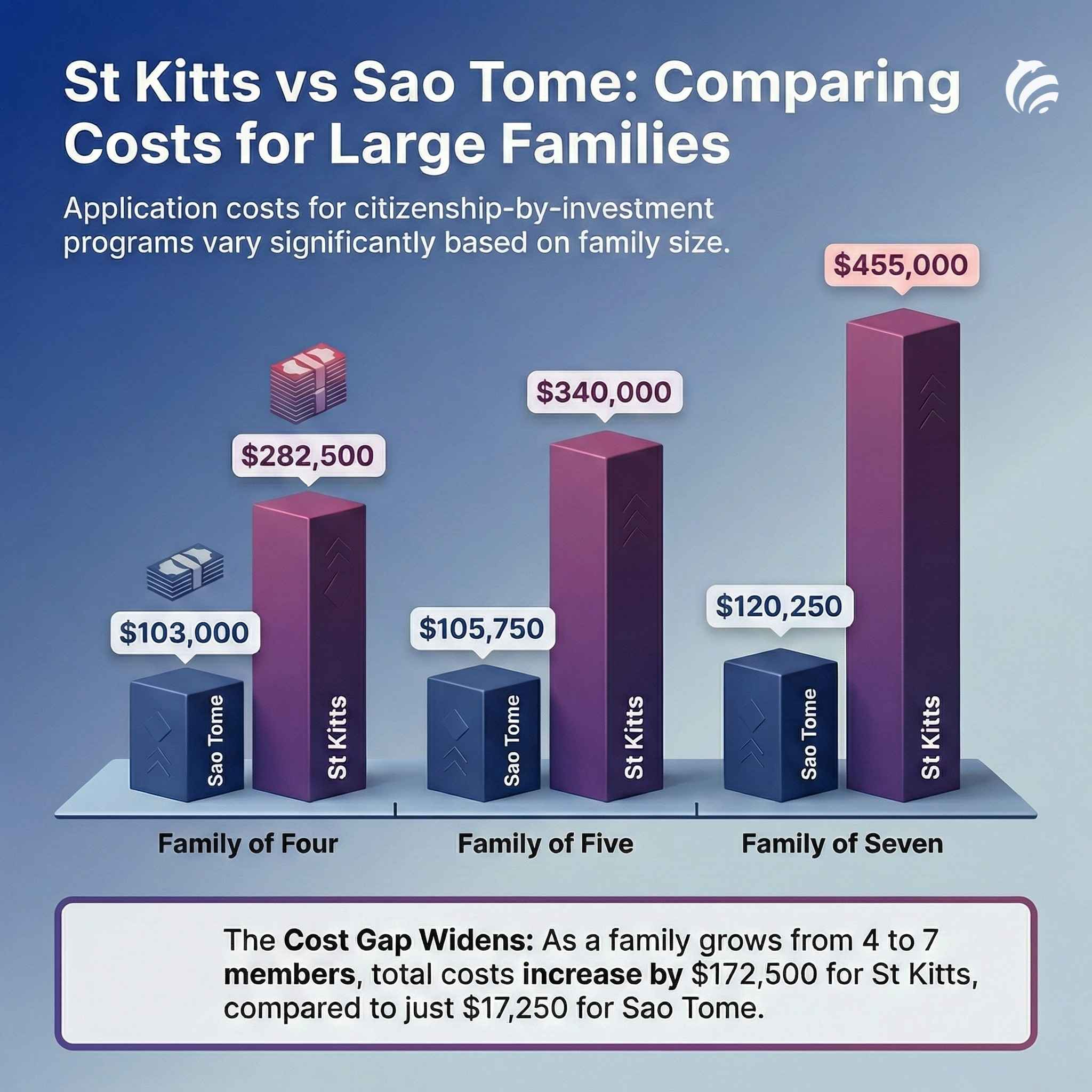
Note: The chart does not contemplate legal fees. Also, it is based on families in which all dependents are older than 16.
Return on Investment
In this article, we're mainly comparing donation options; nevertheless, Saint Kitts has real estate pathways in place. Mundo helps readers obtain exclusively citizenship, and we don't offer investment advice or return on investment.
This must be assessed by the applicant. What we can do is provide our professional opinion based on what clients, experts, and agents are saying.
The main advantage of citizenship is the status in and of itself, and not the returns you can obtain. Actually, the industry has been changing as more and more applicants don't find that a government-approved development fulfills their expectations.
Thus, they are choosing contribution options that are less expensive for them and more helpful for the country's economy. This is why Saint Kitts has recently added the Public Benefit Option, focused on building affordable houses for Saint Kittians and Nevisians.
An interesting fact: the oldest vs the newest
It is interesting to see that Saint Kitts and Nevis is the older CBI (established in 1984) and São Tomé is the newest (established in 2025). This is a fact that should be taken into consideration when evaluating long-term projections.
Summary of Key Differentiators
The following section shows 6 main differentiators and who “wins” that round.
Flexibility – Winner: São Tomé
In terms of flexibility, this is definitely the better option with no minimum stay requirements and more flexible policies.
Costs – Winner: São Tomé
The island constitutes the most cost-effective approach, especially for large families.
Eligibility and dependents – Tie
As one allows grandparents, the other one allows in-laws, and neither accepts siblings. In terms of dependents and eligibility, it's a tie.
Mobility – Tie
This is also a tie since both offer excellent connections, one closer to the Americas and the other one more oriented towards Africa, Europe, and the East.
Speed – Winner: São Tomé
The African country’s processing time is 2 months, against 3-6 months in the Caribbean island.
Reliability – St Kitts
We love this new option, but history is history. The Saint Kitts and Nevis CBI has been standing for over 40 years now, and this means something. Many programs have been established and closed, whether because they finished their term or because they were cancelled.
We never know what will happen, but a program that has been standing for four decades and that is still making adjustments to maintain its reputation and enhance transparency is definitely worth your attention.
Final Recommendation Based on Goals
Finally, it's imperative to analyze the person's case. For large families, the obvious ideal option is São Tomé. On the other hand, if you are looking for a long-standing reputation, no one can beat Saint Kitts and Nevis, the industry’s pioneer.
Special considerations should be taken if the individual has businesses or interests in specific places like Brazil, Portugal, the Americas, etc.
Conclusion: Which Program Suits American Applicants Best?
With that said, we state Mundo's opinion. For Americans, we strongly recommend the Saint Kitts and Nevis program unless the family is too large or unless they have specific interests.
Besides, there are always other alternatives like Vanuatu and the other Caribbean frameworks.
If the applicant is willing to choose residency instead of citizenship, then Panama is definitely the best option, even more convenient than the European golden visa.
Mundo experts can help you with all these applications and also establish trusts, companies, bank accounts, and acquire real estate. We are committed to financial and personal freedom and provide all suitable and reliable tools for the fulfillment of this goal.


.png.small.WebP)


.webp.small.WebP)


$347,000
$309,100
$300,000
$250,000
$424,000
When there's a new program in the CBI world, everyone talks about it. Comparisons are common between...
Today, we go back to analyzing the new African CBI program, which has been on the lips of experts an...
The migration world has been increasingly tied to finances since wealthy people started to choose sm...
The financial world is facing dramatic changes, and structures need to be ready to accompany clients...
When discussing asset protection, there are several myths, marketing lines, and promotions; hence, i...
“Pensionado discount” is a colloquial expression that refers to Panama’s pensionado visa and its lif...