














Panama Digital Nomad Visa vs. Full Residency: What Remote Workers Should Choose in 2026


Introduction: Panama’s Pitch to the Location-Independent Workforce
The digital nomad lifestyle is gaining traction as digital tools evolve and the world becomes more interconnected. Generally, these are people who have strong purchasing power, are well-educated, and can choose to live anywhere they want. It is only logical that they would go to where they are treated best.
Therefore, countries (especially expat-oriented ones) design visas for this peculiar workforce while they attract foreign capital and boost the local economy. The Panama digital nomad visa, like many others of its kind, stipulates a minimum monthly income for the applicant and grants residency for a limited period.
In this article, we analyze the digital nomad visa, Panama as an ideal expat destination, and how this program compares to others.
Why Remote Workers Shortlist Panama: Time Zones, Dollar, and Connectivity
There's something alluring in the country of the canal, and digital nomads know it. Generally, they look for destinations with good connectivity, reliable internet services, a cosmopolitan vibe, and beautiful surroundings. Also, having a relatively easy-to-get residency permit is vital.
Panama ticks all these boxes and more. With the economy pegged to the US dollar, Panama doesn't face inflation issues or volatility problems, matters that concern many of its sibling nations in Latin America. This is why it becomes a preferred destination: for the Latin American investor and freelancer, it offers security and peace of mind, while for the American and Western European digital worker, it offers lower costs and friendlier taxation.
Its location couldn't be better, in the heart of the Americas, and connecting two continents. The bridge of the Americas, Panama, is surely one of the best places for relocation, both for expats and retirees. Its wide range of advantages has earned it the badge of the “best place to retire in the world” several times in prestigious publications.
Landscapes, weather, and lifestyle
The country of the canal enjoys the best of two worlds, and not only because it's just between South and Central America. The isthmus has lovely tropical weather, yet it doesn't suffer from the heavy storms that strike that area. Way South of the hurricane belt, the country boasts outstanding tropical landscapes, dreamy beaches both in the Caribbean and the Pacific Ocean, hilly landscapes, and exuberant forests.
In Panama City, the freelancer and digital worker enjoys a vibrant urban environment and a cosmopolitan ambiance where they can meet a person from a different country every day. They also encounter a variety of ethnicities, religions, and ideas, which facilitates the finding of like-minded people and, in some cases, large communities of fellow countrymen.
Moreover, the Central American capital is characterized by attractive and advanced districts, each appealing to different tastes, from busy neighborhoods to trendy areas and tranquil residential locations.
The Two Paths: Short-Term Permit vs. Long-Term Residency
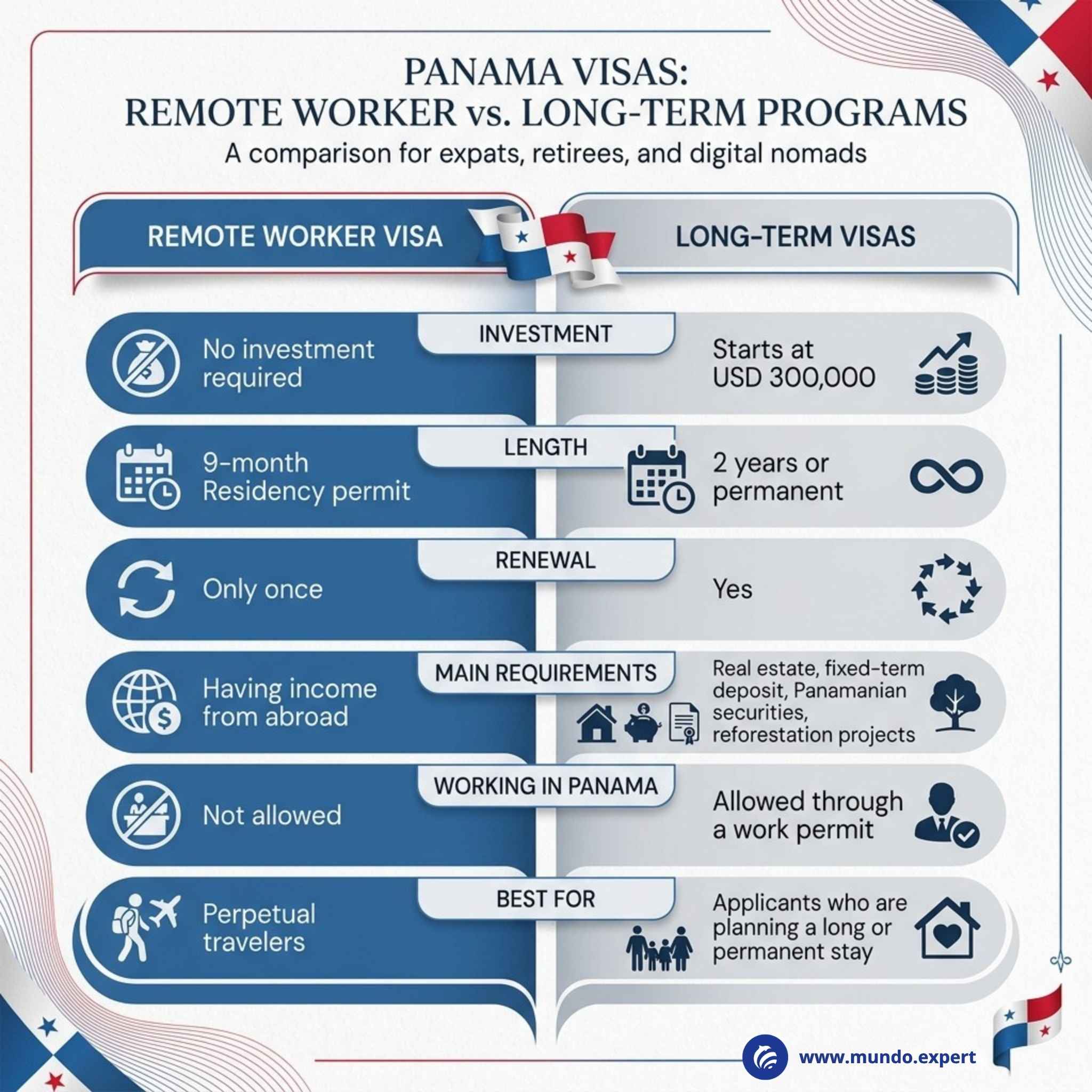
With all these options ahead, digital nomads can choose the Remote Worker Visa, which will give them just what they need: a legal permit to stay longer than a tourist.
Alternatively, they can go for a path that will allow them a longer residency and the possibility of a long-term presence in Panama.
The Digital Nomad Visa in Detail
Income Requirements and Eligible Applicants
The visa known as the Digital Nomad is actually the Remote Worker Visa, and its legal framework is based on Law No. 3 of 2008 and Executive Decree No 198 of May 7, 2021.
All foreign citizens are welcome to submit their application as long as they prove their solvency and the ability to support themselves financially in the country of the canal. The main requirement is having a salary or an income of at least $3000 a month ($36,000 a year) derived from foreign sources.
The expats must receive their income either from their own company, from an employer, or from providing professional services, as long as the activities are conducted outside of Panama. Working in the country is strictly forbidden.
Application Documents
- Panama’s digital worker visa requires the following:
- Copy of the passport, second ID, or any document that proves the applicant's identity
- Document that proves that the applicant doesn't have any criminal records in his/her own home country or in the country where they were previously residing
- Certificate of owning a company, which should be duly registered abroad, and which should be the main vehicle for conducting the applicant's business (specifically for business owners)
- Affidavit describing the relationship between the applicant and his/her clients, including the applicant's and the client's information (for professional service providers)
- The said affidavit must include a description of the services provided, the professional fees charged for those services, and how often they are provided (for professional service providers)
- Bank certificate showing that the applicant receives income from abroad and that it comes from the declared occupation
- Statement from the applicant's foreign bank, proving the transfer of the funds and that they are connected to the declared occupation
Duration, Renewal, and What the Visa Does Not Give You
The Remote Worker visa isn't designed for long-term stays; it is oriented towards people who want to spend a limited season in the country, fitting perfectly with the perpetual traveler and digital nomad lifestyle. In line with this, it grants a permit of nine months, which can be renewed only once. After the first renewal and when the second term finalizes, the applicant must leave the country or change their migration status. For this very same reason, the Remote Worker program doesn't provide a path to citizenship, which can be applied for after 5 years of permanent residency.
When Full Residency Beats the Nomad Visa
Qualified Investor, Reforestation, and Other Investment Routes
If the applicant is willing to invest, there are two main routes to residency: the Qualified Investor and Reforestation. Each of them has its own advantages and characteristics, and both allow either a permanent residency or a temporary permit with the option of renewal.
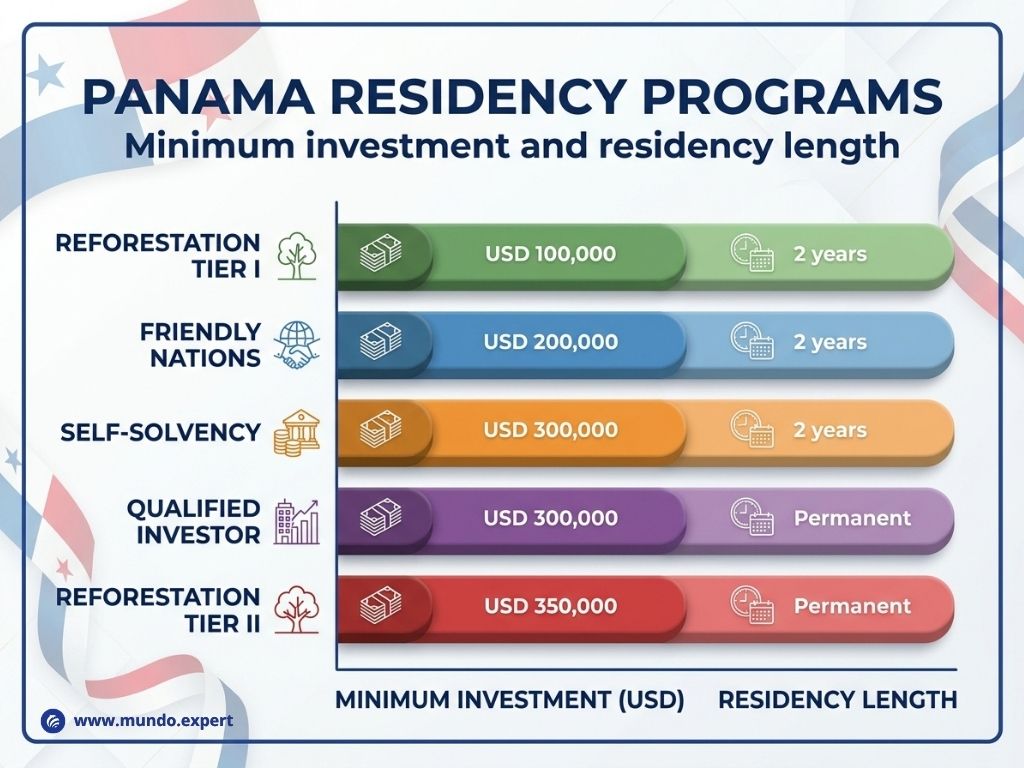
The Qualified Investor offers a direct permanent residency and flexible minimum stay requirements, thus constituting the most cost-effective alternative. Thresholds start at $300,000 for a real estate purchase, a price at which the buyer can obtain modern units in high-end developments, many of which have the same standards as a 5-star resort.
Other tiers of the Qualified Investor include a $500,000 investment in the stock market, in Panamanian commodities, and $750,000 in a fixed-term deposit. In all cases, the investment must be held for at least five years, after which it can be sold or withdrawn.
This positions Panama as a firm competitor to world-class programs like Dubai, which forces you to maintain the investment for as long as you want to keep your residency, and Portugal, which has altogether removed the real estate route.
As for Reforestation, it grants temporary or permanent residency (depending on the amount) and focuses on reforestation programs. The Panamanian government encourages investment in projects that consist of planting, growing, and collecting teak wood.
Self-Economic Solvency: The Middle Path
Visas like the Self-Economic Solvency and the Friendly Nations offer a middle path, granting a 2-year residency permit in exchange for an investment. Friendly Nations is cheaper, but it’s restricted to citizens of certain countries.
Through the Self-Economic Solvency program, applicants can obtain a temporary residency through an investment of $300,000, either in real estate, fixed-term deposits, or a combination of both.
Side-by-Side Comparison
Digital Nomad | Qualified Investor | Reforestation Tier I | Reforestation Tier II | Self-Solvency | Friendly nations | |
Minimum entry | USD 3,000/month | USD300,000 | USD 100,000 | USD350,000 | USD300,000 | USD 200,000 |
| Type | Salary | Investment | Investment | Investment | Investment | Investment |
| Vehicle | Salary | Real Estate | Teak land | Teak land | Real estate/fixed-term deposit | Real estate/fixed-term deposit |
Residency length | 9 months | Permanent | 2 years | Permanent | 2 years | 2 years |
Disclaimer: the information in this article may be inaccurate or outdated at the time of reading. Up-to-date and relevant information will be provided only through formal consultations. This article doesn't constitute legal or migration advice.
Common Scenarios Solved
The US Employee Working Remotely from Panama City
The remote worker visa constitutes an outstanding opportunity for a person working remotely for a U.S. company. Due to the difference in living expense standards, the salary from a US employer will stretch much further in Panama, allowing for a better lifestyle and more indulgences.
The UK Freelancer Testing Panama for a Year
A freelancer who wants to try a place before deciding on a full relocation can surely benefit from the Digital Worker Visa. Without the need for investment, they can stay in the country for a short term, long enough to know if they like it and feel at ease.
Nevertheless, if nine months isn’t enough for a full immersion, and if they are willing to invest, they can apply for the Friendly Nations, as the UK is eligible. The advantage in this case is that they can stay for two years, and if they like Panama, they can later apply for permanent residency.
The Couple Planning Eventual Permanent Relocation
When relocation is part of the plan from the very beginning, the Digital Nomad Visa is not the right option. In this situation, the best and most direct path is Qualified Investor. Without a doubt, buying real estate for $300,000 is the smartest choice because 1) it grants you permanent residency, and 2) you get a place where to live.
Conclusion: Choosing the Right Status from Day One
Decision Checklist
The right residency path is the one that fits your goals. This is why Mundo experts strongly encourage you to establish your objectives clearly and as early as possible. If a permanent relocation is on the cards, don't hesitate and go for a longer residency. On the other hand, if the nomad lifestyle is your choice, with Panama's remote worker visa, you can stay legally in the country and then take wing to the next destination.
How Mundo Experts Structure the Application
Mundo is a team that specializes in second residency, corporate services, trusts, and other tools for the international business person and investor. We are particularly fond of Panama because of its ample advantages and our personal connection to the country. We have a physical office in Panama City, and key members of our team live or have lived here.
This is how we can help you navigate the residency process swiftly, straightforwardly, and safely with the help of our in-house lawyer, who has ample experience in Panamanian and international law.
Contact us and book a consultation


.png.small.WebP)


.webp.small.WebP)


$347,000
$309,100
$300,000
$250,000
$424,000
Investors looking for opportunities in Panama can find an excellent option at Pullman, Panama: apart...
Pullman Hotel and Casino brings a convenient opportunity for investors who want to obtain residency ...
Mundo introduces a unique opportunity in an upscale neighborhood in Panama City: Santa Maria Residen...
Mundo introduces a state-of-the-art project in a residential district in Panama City. The developmen...
This article introduces one of the currently most elite and well-located projects in our portfolio: ...
If many investors are looking at the country of the canal, that's thanks to the Panama Qualified Inv...