









































Company Formation and Compliance in Poland for International Founders — Handled End to End by a Licensed Polish Law Firm


Introduction: Why Poland Became the Default EU Entry Point for International Founders
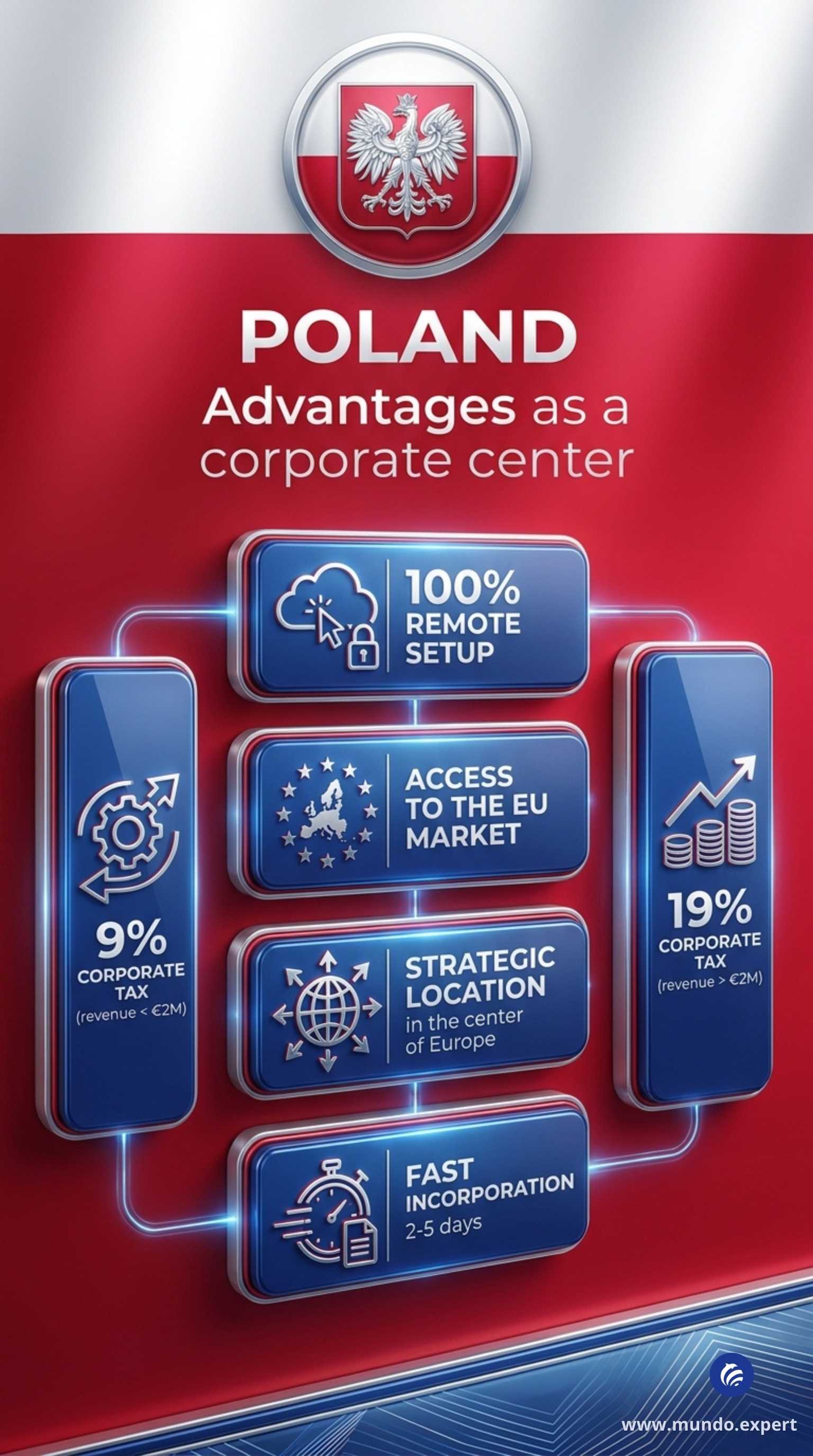
A white-listed, EU-based entity can help streamline operations and seize one of the strongest markets in the world. Through company formation in Poland, businesses can obtain the said benefit with convenient tax rates of 19% (for revenue over €2M) or 9% (for revenue lower than €2M).
Mundo helps you open a Polish sp. z o.o. (LLC) in 2 to 5 days, and after registration, businesses have 14 days to register the UBO at the CRBR, and 3 weeks to file the NIP-8 form, after registration with the KRS. The limited liability company is particularly strong for professional service providers, SaaS, and import/export businesses.
Read the article or send Mundo a message for more information about the Polish structures, functionalities, and benefits.
What "End to End" Actually Means When a Licensed Law Firm Handles Formation
When it comes to corporate services, it is imperative for international founders to count on a reliable provider, and more specifically, a team that can handle the case from the beginning to the end.
The process doesn’t end with registration; it just begins. Compliance, renewals, and reporting must be followed with strict diligence and in accordance with the jurisdiction’s rules, which are subject to constant amendments and are replete with nuances.
Whether in Poland or in any other jurisdiction, it’s convenient to have one team that handles everything from documentation to yearly reporting. Working with a Polish law firm and an end-to-end approach is faster and more cost-effective, while there is less margin for mistakes.
Company Formation in Poland: Who This Guide Is For and Who Should Look for Another Jurisdiction
Poland is ideal for those seeking a fully whitelisted framework and a simple, tax-friendly entry point to the EU. Mundo experts specially recommend a spółka z ograniczoną odpowiedzialnością (sp. z o.o.), or limited liability company, for non-EU founders.
Advantages of Poland as a corporate center:
- Low corporate tax (9% if revenue is less than €2 million)
- Low corporate tax (19% if revenue is more than €2 million)
- Fast incorporation (2-5 days)
- Remote setup
- Consultancy available in English, Russian, and Spanish through Mundo
- EU whitelisted jurisdiction
- Convenient location in the heart of central Europe with access to the Baltic and key routes to Asia
- Provides an EU VAT number
- Possibility of moving goods freely across 27 states of the European Union
- Competitive costs
- Qualified workforce
- Suitable for a wide range of operating businesses with genuine EU substance
- Suitable for import/export and B2B trade with real operations
Register a company in Poland: Choosing the Right Legal Structure
Sp. z o.o.: Why the Limited Liability Company Is the Default Vehicle
Businesses that need structure in the European Union and a solid framework for invoicing, contract signing, and product distribution can highly benefit from the sp. z o.o.
For access to the EU market and framework, it is convenient to register a company in Poland, which offers a much friendlier tax environment than many sought-after EU states, like Germany, France, or the Netherlands.
This is precisely what makes it the most chosen investment vehicle among non-EU founders, as the vast majority of foreign investment in Poland is carried out through the limited liability company.
Prosta Spółka Akcyjna (P.S.A.): The Startup Vehicle for Founders Raising Capital
Due to its low capital requirements and easy liquidation, the Prosta Spółka Akcyjna (P.S.A.), or simplified joint stock company, is optimal for small businesses, new initiatives, and startups.
Branch, Representative Office and Sole Proprietorship: The Narrow Cases That Justify Them
Some business owners prefer to open a branch in Poland. Thus, they access virtually the same benefits as with an Sp. z o.o, albeit with a more flexible structure. Readers should consider that, with a branch, they can run activities within Poland, while with a representative office they can only do advertising.
Structure Comparison: Capital, Liability, Taxation, Time to Register
Consult the following table for an overview of company formation in Poland through different structures and find out which option best suits international founders.
Structure | Minimum capital | Liability | Taxation | Realistic time to register | Best suited for |
sp. z o.o. | PLN 5,000 | Liability is transferred to the members of the management board/board of directors | 19% (9% if revenue < €2M); optional lump-sum CIT — tax deferred until profit distribution | 5 business days | Export and import, digital services, consulting services |
SA (spółka akcyjna) | PLN 100,000 | Liability is on the management board; shareholders not liable | 19% (9% if revenue < €2M); optional lump-sum CIT | ~3–6 weeks (notarial) | Larger ventures, multiple shareholders, capital raising, possible listing |
Branch of a foreign company | No minimum capital | Liability falls on the parent company | 19% only on revenues generated in Poland | 2 weeks- 2 months | Foreign businesses that want to operate in Poland |
The table above shows us why the sp. z o.o. is the default vehicle for the large majority of foreign founders. Please compare it with another alternative, the SA (joint-stock company), which suits larger ventures with higher capital and multiple shareholders.
Two further forms exist but are niche and generally unattractive for foreign founders: the P.S.A. (simple joint-stock company), aimed at VC-backed startups, and partnerships (spółki osobowe), which carry unlimited personal liability.
Structures like a branch or a PSA have minimum or no capital requirements, yet they take longer to establish. All in all, the local Sp. z o.o is the most convenient vehicle when it comes to company formation in Poland, catering both to EU and non-EU founders.
The Formation Process Step by Step
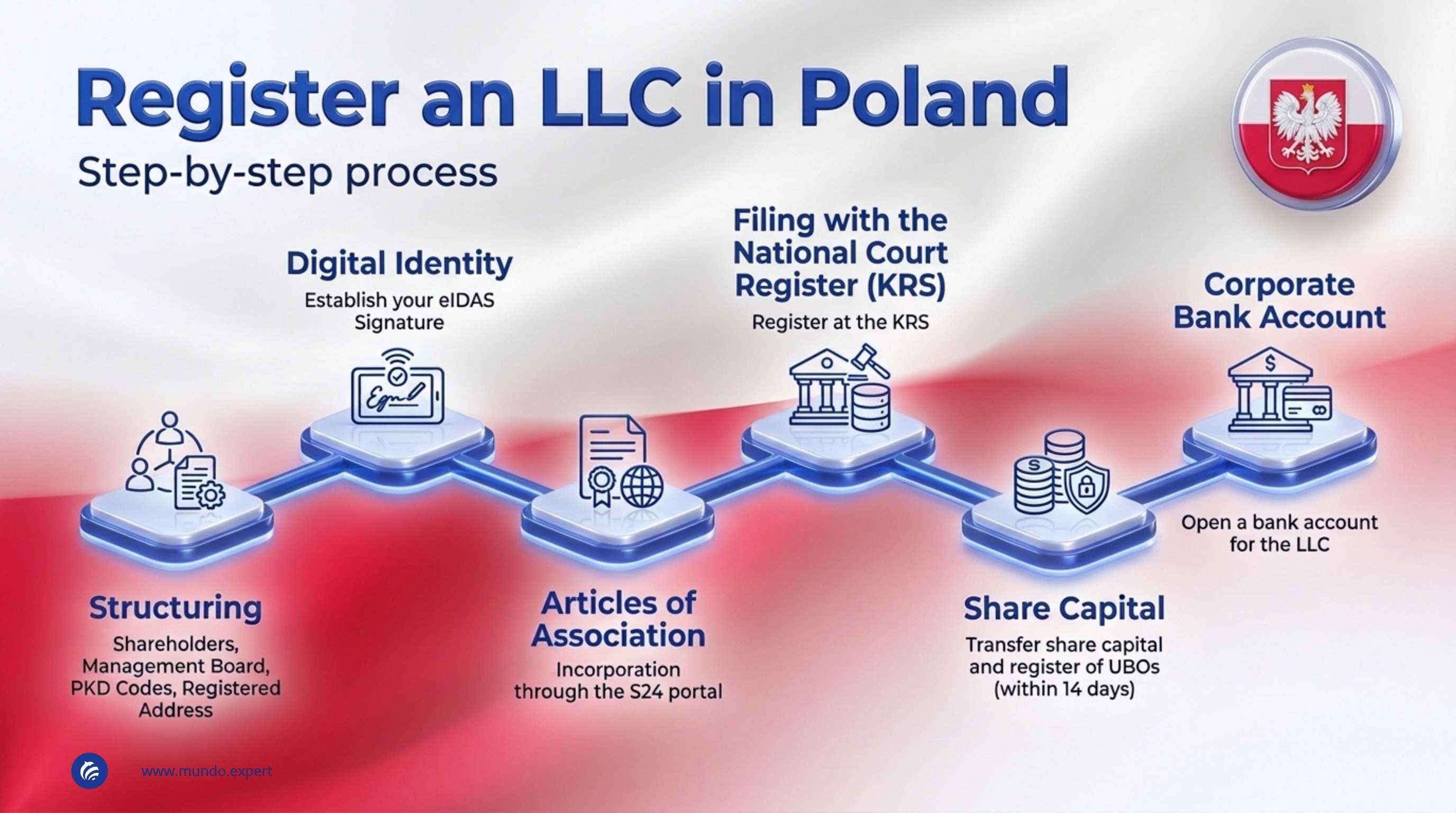
Step 1: Structuring — Shareholders, Management Board, PKD Codes, Registered Address
Once again, the limited liability company shows exceptional flexibility as directors and shareholders can be from abroad. When it comes to liability, shareholders are not liable for the company’s debts.
Management board members may become personally liable for the company’s debts if enforcement against the company is ineffective (art. 299 of the Commercial Companies Code), unless they filed for bankruptcy in time.
Moreover, the number of mandatory shareholders is minimal (one shareholder is enough to establish an sp. z o.o.), and a physical address is mandatory. Founders should have special considerations as to how taxation works, and beware of the single-shareholder trap (see the corresponding section below).
Entities must file for a Polska Klasyfikacja Działalności (PKD code), which classifies the company in terms of business operations in its specific sector. The PKD codes serve the purpose of deriving statistical data. Recently, the PKD codes have been updated to encompass a wider, more modern range of sectors like green economy initiatives and digital services.
Step 2: Digital Identity — Qualified eIDAS Signature vs ePUAP Trusted Profile and PESEL
To legally register a company in Poland, the founder must have an eIDAS-compliant signature, or any qualified electronic signature. This eIDAS system establishes a legal framework to validate digital identity through electronic documents, signatures, stamps, and certificates.
Having an eIDAS, as well as other similar services like PESEL and ePUAP, is not a mandatory rule for establishing an sp. z o.o. Instead, it becomes compulsory when submitting articles of association remotely, which takes us to the following point.
Step 3: Articles of Association — S24 Template vs Notarial Deed
Articles of association can be submitted either online, through a portal called S24, or in person before a public notary. At this stage, foreign founders must submit the resolution of directors, proof of share capital contribution, and information concerning the officers (including signed consents, proofs of address, and information on the beneficial owner).
Step 4: Filing with the National Court Register (KRS) and Automatic NIP and REGON Issuance
The registration of the company with the Krajowy Rejestr Sądowy (KRS), or National Court Register, is always done through digital channels; the only difference lies in which platform.
If the limited liability company was established via S24, registration is done through the same one. On the other hand, if it was registered traditionally, the submission must be sent through the National Court Register’s portal (known as PRS).
Step 5: Share Capital, PCC Transaction Tax and the 14-Day Clock
After transferring the minimum share capital of PLN5,000 (approximately €1160)* and registering the company, there are mandatory timeframes to fulfill certain registration and tax obligations.
Within 2 weeks, directors are bound to register the ultimate beneficial owner (or owners) at the CRBR and submit a tax return proving they have paid the registration tax (PCC). Said tax is 0.5% of the share capital.
Within 14 days (2 weeks), they are required to submit the NIP-8 tax form, through which the entity reports supplementary operational details like contact addresses, the existence of a bank account, and the accountant information, whether carried out by a professional or a firm. If this information changes at any given time, the update must be made within 7 days.
* Exchange rate at the time of writing is €1,00 : zł4,31
Step 6: Corporate Bank Account for the sp. z o.o. or the real challenge for Foreign-Owned Companies
Opening a bank account for the sp. z o.o. is mandatory, so that the corporate assets (and the liability) remain separate from personal funds.
Foreign founders face higher due diligence and stricter KYC policies, which is why they must get ready for a longer wait. The bank account opening is the largest stage in the process of company formation in Poland.
Realistic Timeline: From First Call to First Invoice
The following table displays estimated steps and time frames for each stage. Stages can vary in order and length, and time frames are approximate as they depend on external factors.
| Stage | Description | Who acts | Timeframe | |
Step 1 | Onboarding | Decide key elements like name, shareholders, and capital | Client with Mundo expert and Polish specialist | 1 week |
Step 2 | Gather documents | Company excerpt, ID, power of attorney | Client with Mundo expert and Polish specialist | 2-3 weeks |
Step 3 | Registration | Register the structure | Mundo expert and Polish specialist | 5 business days |
Step 4 | VAT registration (only new companies) | Register the structure under the VAT system | Mundo expert and Polish specialist | 4-8 weeks |
Step 5 | Registration at the KRS | Register LLC under the National Court Register | Mundo expert and Polish specialist | 1-2 days |
Step 6 | Submit tax information | NIP-8 | Mundo expert and Polish specialist | Within 3 weeks |
Step 7 | Open bank account | Submit details on the company’s activities, contractors, income sources, services/products offered | Client with Mundo expert and Polish specialist | 2 weeks to 3 months |
In the table above, we can see how registration doesn’t represent a problem. When they want to register a company in Poland, foreign founders find a fast and achievable system in 5 business days.
Nevertheless, international founders face stricter compliance and KYC processes at the moment of opening a bank account, which is mandatory for the entity to operate. Note that some stages in the table occur simultaneously, so the time frames should not be added up.
Do you want to never miss a deadline? Get in touch with Mundo experts and ask for more information.
The True Cost of Forming a Polish Company
State Fees, Notarial Costs, Sworn Translations and Apostilles
The price for setting up a new company starts at €1500, without including legal services, costs, or expenses. As to the services, this is the cost of a package that includes electronic registration, VAT and EORI registration, and one year's registered address.
Legal Fees: What a Fixed-Fee Engagement Should and Should Not Include
At the time of writing, the Mundo team can offer you a set of packages which are designed to cover different needs.
One of them includes the above-mentioned information and dormant accounting (for a limited period of time). Some international founders prefer to acquire a ready-made entity to simplify processes. This service is available too, at a slightly higher fee.
Recurring Annual Costs: Accounting, Registered Office, Statutory Filings
Companies in Poland must pay annual fees and ensure compliance for as long as they exist. Luckily, thanks to our experts, we can help you with VAT reporting, technical accounting, and annual financial statement preparation, as detailed in the following table.
The prices included are for the most popular structure, the Poland Limited liability company, and they are provided not as definitive numbers, but as the starting fees without including legal expenses.
Service | Fees* | Details |
New company | EUR1,500 | Includes electronic registration, VAT and EORI, registered address for 1st year |
Ready-made company | EUR2,200 | Includes electronic registration, VAT and EORI, registered address for 1st year |
Ready-made company | EUR3,000 | With 6 months of dormant accounting |
Qualified electronic signature | EUR350 | For the shareholder |
Ongoing accounting | Dormant: EUR50/month | Up to 5 documents/month (dormant) |
VAT reporting | EUR250 | Up to 100 documents per month |
Technical accounting plus VAT | EUR400 | Up to 100 documents per month |
Full accounting | USD500 | Includes financial statements |
Annual financial statements, registry filings and specific legal work | Quoted case by case | Based on the company’s needs |
*These numbers don’t include legal services, costs, or other fees. Definitive quotations are provided only through formal consultations.
Even though the table above doesn’t show the final fees, it still demonstrates how Poland can be a superb corporate center for international founders. Its approach is relatively simple, and the minimum capital is affordable (roughly €1100). For fee information specific to your case and business, contact us and schedule an appointment.
The First 90 Days After Registration: Where Founders May Lose Control without Proper Assistance
CRBR: Reporting the Ultimate Beneficial Owner and the PLN 1 Million Penalty Exposure
With programs like the CRS or BEPS, the corporate world has been pushed towards transparency; hence, most jurisdictions demand full disclosure of the beneficial owner or owners.
In Poland, the registry of UBOs is mandatory within 14 days after registration, and failure to comply can result in a PLN1,000,000 (€230,000) fine.
NIP-8 and VAT Registration: When VAT-R Is Actually Required
VAT in Poland is directly connected to the types of business activities, transactions, and goods and services provided. In short, this applies to companies that are active in Poland, whether selling, storing, transporting, or importing goods.
Although some structures may be eligible for a VAT exemption, this depends on the case and applies only to small businesses (with a threshold of PLN 240,000 (€55,000)).
ZUS: Employees, Board Members and the Single-Shareholder Trap
Even if the LLC doesn't have any staff, it has to be registered at Zakład Ubezpieczeń Społecznych, (ZUS), which is the Social Insurance Institution. The registration is made automatically after the company is filed with KRS and submits the NIP-8 form.
When hiring an employee, it’s mandatory to register them within seven days, presenting a copy of the tax office's decisions granting the company a tax ID and a REGON certificate.
ZUS is mandatory for sp. z o.o. that have a single shareholder, in which case they must pay social security and health insurance contributions. This rule is popularly known as the “single shareholder trap”.
KSeF Mandatory E-Invoicing: What the 2026–2027 Rollout Means for a New Company
Krajowy System e-Faktur (KSef) is the country's mandatory platform for invoice issuing. Through its browser and mobile app versions, it allows businesses to create, store, and handle invoicing straightforwardly.
E-invoicing brings several advantages to the table, the main ones being accessibility and flexibility. It allows for creating drafts, facilitates legal procedures such as VAT recovery, document preparation, easy access to old invoices (up to 10 years back), and integration with the company’s accounting systems.
Being relatively new, KSeF is being implemented gradually. The largest taxpayers (sales over PLN 200 million) must use it from February 1st, 2026; all other taxpayers from April 1st, 2026; and the smallest taxpayers (monthly sales up to PLN 10,000) from January 1st, 2027.
Compliance Calendar: Deadline, Filing, Consequence of Missing It
The following compliance calendar shows the main steps to take after formation, as well as the entities involved and enforceability.
Obligation | Deadline | Filed with | Consequence of missing it |
CRBR | 14 days after the registration of the entity and 7 days after any change in the UBO information | Central Register of Beneficial Owners | Fines or criminal liability |
NIP-8 form | 3 weeks after registration with the National Court Register, 7 days from the date of commencement of business | Tax office | Fines |
PCC tax | 2 weeks since registration | Tax office | Consult with our experts |
VAT-R | 25th day of the month following each consecutive accounting period | Tax office | Consult with our experts |
ZUS (social insurance) | 7 days after your contractor starts employment | Social Insurance Institution | Consult with our experts |
KSeF onboarding | >PLN 200M: 1 Feb 2026 | all others: 1 Apr 2026 | smallest (≤PLN 10k/month): 1 Jan 2027 | Ksef Official platform | Financial penalties |
Financial statements filing (KRS) | July 15, 15 days after approval | National Court Register | Financial penalties |
Annual financial statements | Within 3 months after the end of the financial year | National Court Register | Financial penalties, criminal liability, deregistration of company |
CIT return | March 31 of the following year | KAS (National Revenue Administration) | Accrual of interest, arrears, criminal liability |
Financial statements to the KAS (if applies) | July 15 | KAS (National Revenue Administration) | Financial penalties |
Through the above table, the prospective business owner can see how every step is compressed in a 2-week window after registration. Annual obligations, like tax filings, take place on a specific date, usually around March/April during the following fiscal year. While the table provides a general overview, it doesn’t replace formal consultation or ongoing advice from a Polish law firm or certified professionals.
Ongoing Compliance, Governance and Tax Positioning
Corporate Income Tax: 19%, the 9% Small-Taxpayer Rate and the Estonian CIT Model
Corporate income tax is relatively low for an EU country: 19%. It gets even better for businesses making less than €2M, which are taxed at a 9% rate. Polish companies can also opt for the lump-sum, reinvestment-based CIT (formally “ryczałt od dochodów spółek”), which lets a company defer CIT until profits are distributed.
This allows for reinvestment and growth before the moment of distribution, when tax rates are 10% and 20% (for smaller or larger businesses).
Dividends, Withholding Tax and Double Tax Treaty Relief
Dividends are subject to 19% withholding tax. The combined effective burden (corporate + dividend) depends on the CIT model: under the lump-sum (reinvestment) CIT, it is roughly 20% for small taxpayers and 25% for others; under the standard CIT, it is higher.
A smart approach is to use the numerous tax relief treaties maintained by Poland with other jurisdictions. If carried out together with a certified tax advisor, this strategy can reduce the dividend withholding, often to 5–15%.
Substance, Related-Party Transactions and Why Banks Ask About Them
One of the advantages of incorporating in the EU and using tax schemes accepted by the union is the possibility of combining compliance with tax reliefs. If all legal aspects are covered, the business doesn’t have to go the extra mile to demonstrate its standing, as it already nests within the system that stipulates such rules and regulations in the first place.
Disclaimer: The information provided in this article about corporate regulations and fees in Poland might be outdated at the time of reading. Up-to-date and case-by-case information is only provided through formal consultations.
Why an International Founder Should Use a Licensed Provider or Polish Law Firm, Not an Incorporation Portal
Regulated Status, Professional Indemnity Insurance and Legal Privilege
Legal services may be easy to understand on paper, yet when it comes to registration and compliance, it’s a whole different deal. No one can be up to date on taxation, registration, time frames, and nuances like a dedicated expert who spends all his/her working hours on this. Legal schemes are complex per se, and they change constantly, a fact that makes them harder to approach.
Power of Attorney: Getting Registered Without Ever Landing in Poland
Finding the time for travelling is particularly challenging for international founders and businesspeople. This is one of the advantages of Poland: it allows you to form the structure 100% remotely through a power of attorney.
Polish regulations also dictate that founders accept the engagement terms and sign an AML declaration with the firm handling their case locally.
Where Cheap Formation Packages Fail: Wrong PKD Codes, Unusable Articles, Rejected Bank Files
A safe path to legal services is not the cheapest, but the consequences of relying on negligent providers are by far more expensive. What’s worse, there can be legal consequences, fines, and irreparable damage to reputation.
When someone wants to register a company in Poland, they find lots of edges and parameters to consider, from PKD codes to PCC tax, CRBR, NIP-8 form, ZUS obligations, and Ksef e-invoicing. This is very hard to follow up with, especially for those who don’t understand Polish.
How the Mundo Poland Service Works
Scope of Engagement: Formation, Tax Registration, Banking, Accounting, Compliance Calendar
We are proud to present an end-to-end service that will cover all your needs from the moment you decide to open your sp. z o.o. to the reporting and filing throughout the years.
Clients are assisted in every step by the assigned Mundo expert, while the implementations are carried out by professionals in Poland.
What We Need From You, and What You Receive at Each Stage
We can't stress this with enough zeal: what we need from you is complete honesty and openness. We work with licensed players, and we ourselves have licenses to provide a number of legal and migration services, yet the only way in which we can do our job right is if we obtain the same from your side.
Fixed Fees, Timelines and What Sits Outside the Package
The final fees are shared only through formal consultations and provided on a case-by-case basis. All fees stipulated in this article don't include legal fees and expenses, and they might be outdated at the time of reading.
Contact us and have your legal company ready straightforwardly
If you want to register a company in Poland, let’s talk. Non-EU founders can enjoy tax benefits, full compliance, and provable substance. We can help you establish your structure effectively in Poland, the UK, Panama, Hong Kong, the US and several other convenient jurisdictions.
Consult us about other services like trusts, economic citizenship, residency, and real estate. Our team is composed of various experts from different backgrounds and speaking different languages, which allows us to help a wide range of clients and interested parties.
Frequently Asked Questions
Can a foreigner register a company in Poland without visiting the country?
Do I need a PESEL number to form a sp. z o.o.?
How much share capital do I really need, and is it a fee?
How long does company formation in Poland actually take, start to finish?
Does my Polish company need to register for VAT immediately?
What is CRBR and what happens if I file the UBO late?
When does KSeF e-invoicing apply to a newly formed company?
What does an end-to-end engagement include?


.png.small.WebP)


.webp.small.WebP)


$347,000
$309,100
$300,000
$250,000
$424,000
Investors looking for opportunities in Panama can find an excellent option at Pullman, Panama: apart...
Pullman Hotel and Casino brings a convenient opportunity for investors who want to obtain residency ...
Mundo introduces a unique opportunity in an upscale neighborhood in Panama City: Santa Maria Residen...
Mundo introduces a state-of-the-art project in a residential district in Panama City. The developmen...
This article introduces one of the currently most elite and well-located projects in our portfolio: ...
If many investors are looking at the country of the canal, that's thanks to the Panama Qualified Inv...