



































Panama Reforestation Visa: Residency Through a Sustainable Forestry Investment


Introduction: The Greenest Path to Panamanian Residency
When discussing Panama residency, we often mention the old-time favorites: Pensionado, Friendly Nations, and Qualified Investor. However, the local residency landscape encompasses options that can surprise with their flexibility, sustainable approach, and long-term benefits.
For instance, the Panama Reforestation Visa offers two separate thresholds, which makes it the most cost-effective entry without depending on factors other than the investment itself.
Those who don’t have a lifetime pension to qualify for Pensionado, or who aren’t on the list of the 50 friendly nations, can find a non-expensive alternative through the Forestry Program.
With that said, we introduce you to this article about the Reforestation Visa, Panama, and how to obtain permanent or temporary residency through a sustainable initiative.
Why Panama Promotes Forestry Investment (Law 24 and Beyond)
A residency based on a green investment is certainly interesting, especially in Panama.
Planting teak helps the soil recover its nutrients and protects those hectares from intensive agriculture and cattle ranching. It helps ecosystems thrive while protecting flora and fauna, which aligns with Law 24 of 1995.
Since the government passed Law 24 in 1995, all the isthmus’s wildlife is considered national heritage and must be protected by law. Law 24 not only protects wildlife; it promotes conservation, fosters research, and encourages local authorities to take an active role.
Furthermore, Law 24 regulates hunting and fishing practices, and the collection, extraction, commercialization, and usufruct of Panama's wildlife products and subproducts.
This shows two things: how the Panama government is environmentally conscious and how it directs this initiative to the migration sector.
Who Chooses the Reforestation Route and Why
The forestry pathway has become a foothold for those who don't qualify for the most popular programs. Its higher threshold facilitates eligibility for permanent residency, thus providing a direct path to those who are planning a full relocation and aspire to citizenship eligibility. Parallelly, the lower tier stipulates a friendlier investment, yet the residency span is shorter (two years).
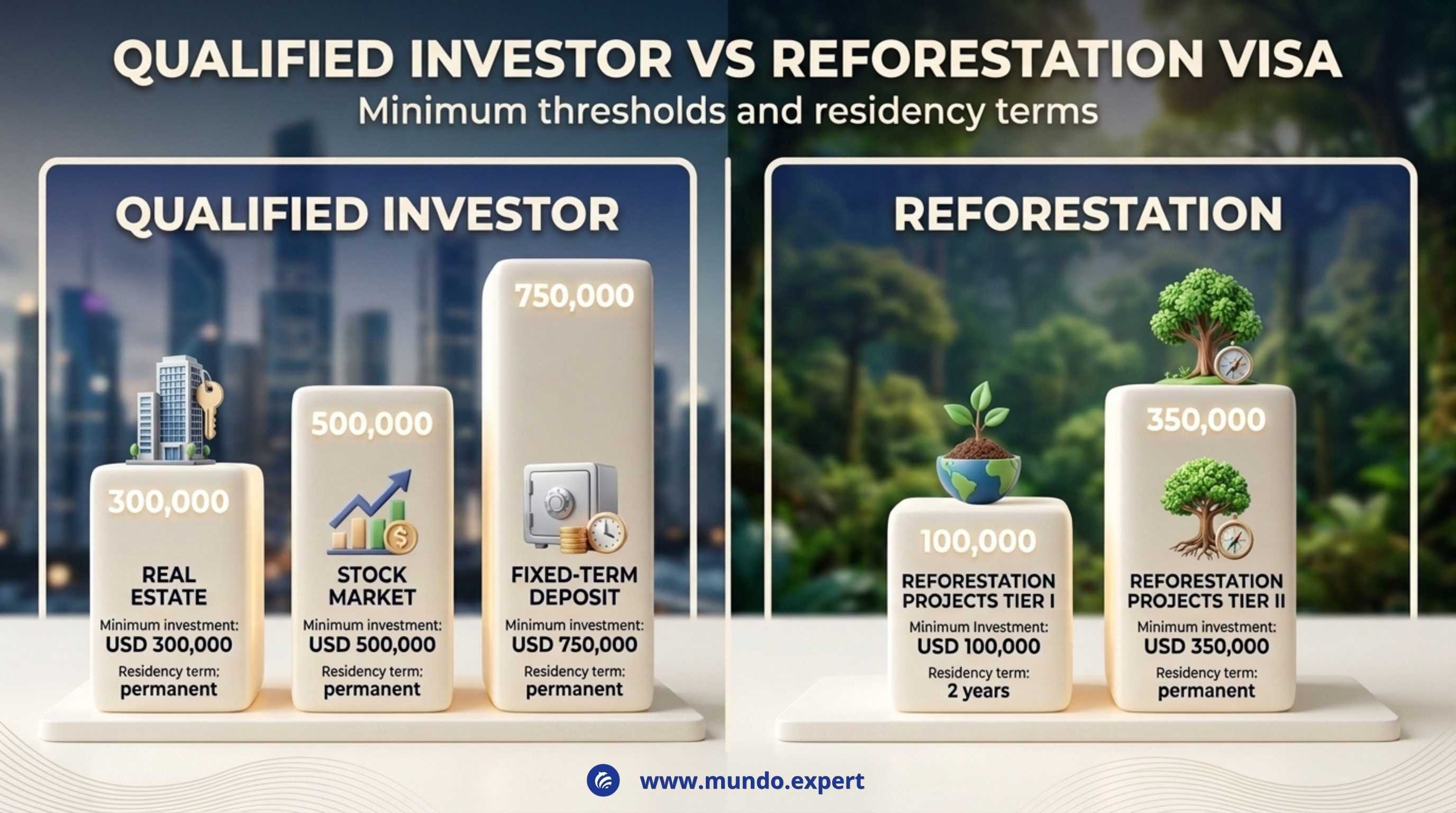
As we can see in the following paragraphs, both tiers of the forestry visa are focused on one single investment: reforestation projects. In this sense, it’s different than other visas, like Qualified Investor, which includes three separate vehicles (see the table below for a comparison).
Program Tiers and Investment Thresholds
The $100,000 Option: Two-Year Temporary Residency Track
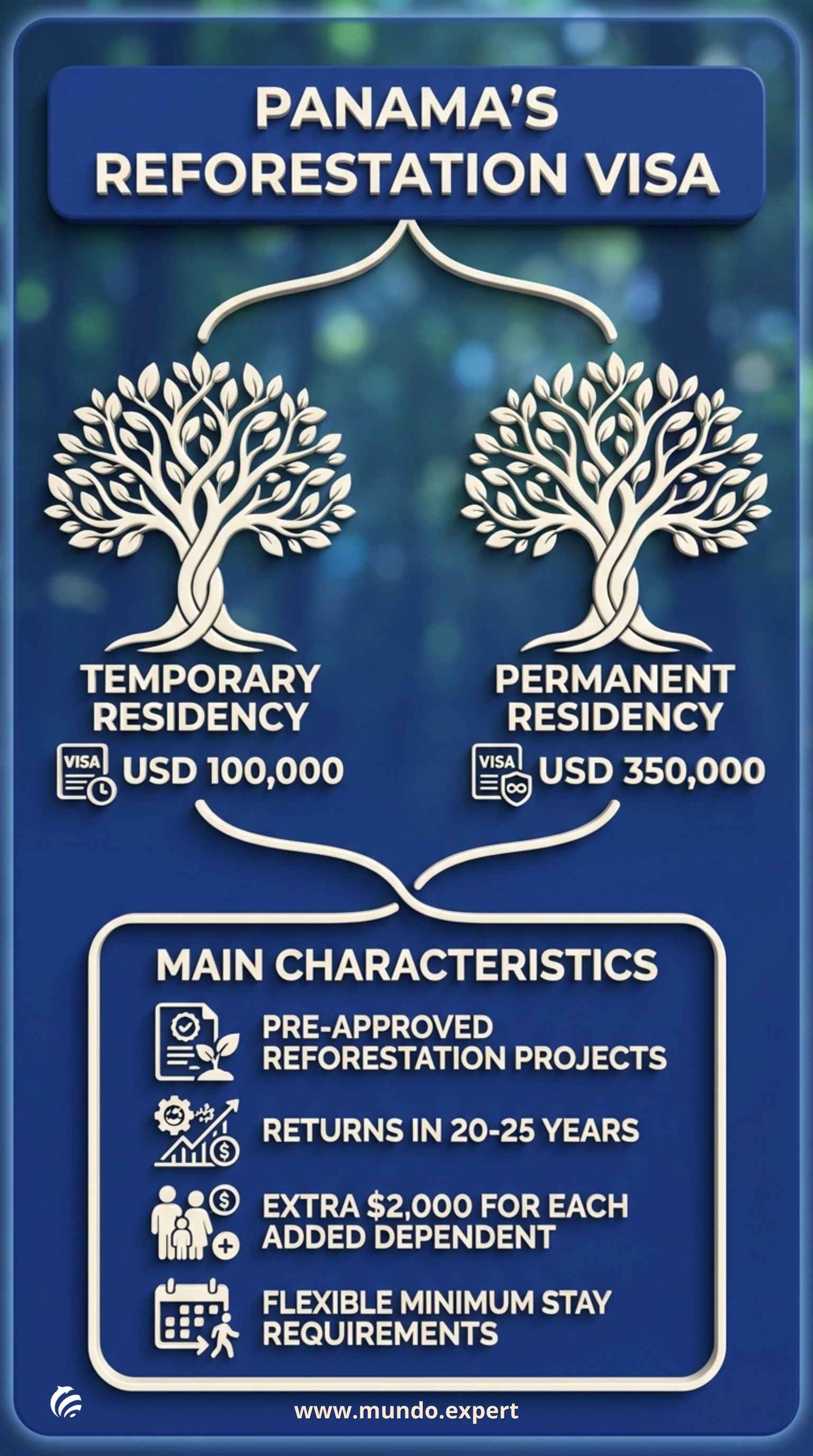
The investor can choose to buy land with a value of $100,000, thus opening the doors to a temporary residency, which can be later renewed to a permanent status. For those who want immediate permanent residency, there's a second tier that allows you to acquire more land and obtain the coveted benefit.
The $350,000 Option: Direct Permanent Residency
By investing $350,000, the applicant is eligible for immediate permanent residency, as established in Article 180, modified through Executive Decree No. 199 of May 2021. This makes it the only immediate permanent residency, together with the Qualified Investor option. Both programs are similar in entry costs and resident benefits, yet they have key divergences, as we can infer from the table below.
What You Actually Buy: Teak Parcels and Certified Projects
Article 180 stipulates that the investment is made in reforestation projects authorized by the Environment Ministry. In simple words, the applicant must invest in a parcel or parcels to plant and harvest teak trees. Rather than wearing the land down, this kind of agriculture builds it back up, restoring nutrients instead of stripping them away, while the investor can profit at the time of collecting and selling the timber.
Even though the waiting time is expected to be 15-25 years, it’s a perfectly viable option, especially for those who want to pay for their children’s college or save up for their retirement years.
Evaluating a Reforestation Project Before Investing
Several firms are fully dedicated to residency-approved reforestation projects. In exchange for a fee, they take care of everything for you, from planting to administration and accounting.
Government Certification and Forestry Registry Checks
Researching the company is key for two reasons. Firstly, it ensures you are in business with a reliable provider that will deliver, which is vital in processes with long life spans, such as this one. Secondly, the applicant should confirm whether the parcel is eligible for the Reforestation program. Both the financial and migration flanks should be covered to avoid unpleasant surprises and make sure the results are optimal.
What Return on Investment can you expect from teak?
Teak makes an exceptionally strong and resilient timber. Its strength, resilience, and smooth appearance make it a highly demanded product ideal for solid construction and design. Its exceptional resistance to humidity makes it ideal for patio furniture, pergolas, and ships, while its refined look makes it perfect for indoor decor.
As for the investment, it allows for period thinning and total harvest, which happens in a period between 15 and 25 years.
Application Process and Documents
Visa Requirements and Documents
Applicants must provide the following
- Power of attorney
- Three photographs
- Copy of the passport (must be notarized and authenticated)
- Clean criminal record
- Health certificate
- $250 check to the National Treasury
- $800 check to the National Migration Service
- Personal history statement
- Certificate issued by a certified public accountant; it must stipulate the total invested amount in detail, which must be directly invested in a reforestation project. The certificate must prove that the money comes from the investor.
- Copy of the accountant’s cedula and professional license
- Copy of the share certificate in favor of the investor or a contract between the forestry business and the applicant
- Copy of the resolution issued by the Environment Ministry demonstrating that the applicant’s reforestation is registered
- Certificate proving the existence of the company; the certificate must be issued by Panama’s public registry, and it must state the company's activities
- Ownership certificate issued by Panama’s public registry
- Bank statement to prove that the investment was duly made in forested projects with a minimum of $100,000 or $350,000
- If the investment is made in the name of the company, the applicant must present an affidavit that states the activities, title of shares in favor of the applicant, and the capital stock*
*The affidavit can’t be issued by the applicant; it must be issued by a third party within the company (the treasurer or secretary).
Government and Legal Fees Breakdown
When it comes to government fees, the Forestry Program is surprisingly convenient, stipulating a $250 payment to the National Treasury and $800 to the Immigration Office. This, however, doesn't include expenses, costs, and legal fees.
Mundo editor’s opinion: "Applicants who need a cost-effective second residency should definitely be looking at the Reforestation Visa. Its 100,000-dollar threshold grants a 2-year permit with the possibility of renewal, and it doesn't have any eligibility restrictions like Pensionado or Friendly Nations".
Family Inclusion: Spouse and other Dependents
Most Panama residency programs allow the inclusion of the closest family members; in this case, the spouse and children. For each added dependent, applicants must add an extra $2000, which can be justified through a bank reference.
How to obtain Panama residency through a teak plantation: the reforestation program timeline
Step one: consultation with your expert
Contact our team so you are assigned an expert to walk you through the process. Together, you will design the right strategy, whether through Reforestation, Qualified Investor, Pensionado, or any other Panama program.
Step 2: Choose the teak land management company
In this sense, reforestation is much more straightforward than real estate, as there are fewer timber-management options than apartments. Mundo can introduce you to reliable players with experience and ample credibility in the field.
Step 3: Gather all documents and fill out the forms
Your Mundo expert will be with you every step of the way. One of our main assets is our in-house lawyer, who is an expert in navigating bureaucracy and avoiding unnecessary pitfalls. With the Mundo team, you'll have all the support you need to prepare your documents and fill out the forms.
Step 4: Travel to Panama
Even though hiring a lawyer is mandatory, applications must be submitted by the applicant in person. This means they need to be physically present at the Immigration Office. Talk to your Mundo expert to find out when to travel and for how long, as this will entirely depend on the evolution of your case.
Step 5: Approval
At the moment you receive the letter of approval, you will also be given a permanent or temporary resident card, as applicable.
Disclaimer: the information in this article is provided for a general overview only. Up-to-date and case-by-case information will be provided only through formal consultations. This article doesn't constitute legal or migration advice.
Reforestation vs. Other Panama Residency Programs
Comparison with Qualified Investor and Pensionado
Reforestation | Reforestation | Pensionado | Qualified Investor (Real Estate) | |
Minimum investment | USD 100,000 | USD 350,000 | Lifetime pension USD1000/month | USD 300,000 |
Residency term | 2 years | Permanent | Permanent | Permanent |
| Type | Teak land | Teak land | Pension income | Real Estate |
| Focus | Investing in teak plantations to collect and sell timber | Investing in teak plantations to collect and sell timber | Retirement | Investment returns |
Main advantage | Sustainable initiative with long-term benefits | Sustainable initiative with long-term benefits | Low-cost retirement residency with no age restrictions | Direct permanent residency |
Alternative paths | No | No | USD100,000 in real estate + USD750 lifetime pension | Fixed-term deposit and Panamanian securities |
Ideal for | Applicants who want a cost-effective entry without depending on external factors | Applicants who expect to obtain a return on investment in the long-term | Applicants of any age with a qualifying pension | Applicants who need permanent residency fast |
FAQ: What most people want to know about the Reforestation Visa in Panama
What is the minimum if I want to invest in teak land in Panama?
The minimum investment is $100,000 for a two-year permit and $350,000 for permanent resident status.
Am I allowed to renew my 2-year visa?
Yes. Before the visa expires, you can extend it and eventually obtain permanent residency and citizenship.
How do I know if I'm eligible for citizenship?
All foreigners who have been living permanently in Panama for five years, with legal permanent residency, can apply for naturalization. The process requires relinquishing all previous nationalities and passing an exam on Panamanian history and the electoral court.
Conclusion: A Residency That Grows on Trees
Even though this is not the most discussed or famous program, Reforestation is definitely a good choice for those looking to relocate. Offering both a temporary and a permanent visa, depending on the investment amount, the program is highly flexible, and it can fit different budgets.
With a reliable management company, the plantation, the parcel, and the timber are managed for you, along with the legal aspects. All in all, this is the perfect option if you are looking for a cost-effective entry and don't mind waiting a couple of decades to obtain a return on investment.
Who we are
Mundo is a dedicated team and an online journal that specializes in Panama residency, foundations, corporate services, and real estate. We have a deep connection with the country of the canal since many of our team members live here, and we have a physical office in the heart of the Central American capital.
Besides, we can help you establish structures and deploy tools in different jurisdictions like Hong Kong, the UK, Seychelles, and the US for company incorporation, the island of Nevis for trusts, and the Caribbean, Vanuatu, and São Tomé for citizenship. Get in touch now and book a consultation.


.png.small.WebP)


.webp.small.WebP)


$347,000
$309,100
$300,000
$250,000
$424,000
Investors looking for opportunities in Panama can find an excellent option at Pullman, Panama: apart...
Pullman Hotel and Casino brings a convenient opportunity for investors who want to obtain residency ...
Mundo introduces a unique opportunity in an upscale neighborhood in Panama City: Santa Maria Residen...
Mundo introduces a state-of-the-art project in a residential district in Panama City. The developmen...
This article introduces one of the currently most elite and well-located projects in our portfolio: ...
If many investors are looking at the country of the canal, that's thanks to the Panama Qualified Inv...